English
 Bangla
 Arabic

















Details description |
|---|
|
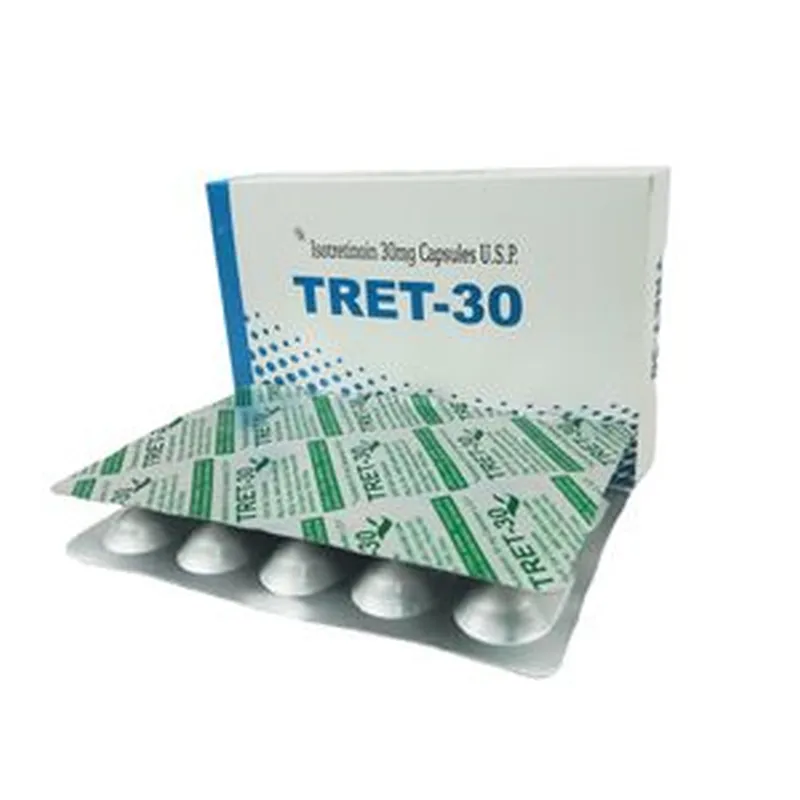
Tret 30 - capsule
Isotretinoin - 30mg
30 Capsule(s) / Box
Promayer Health & Nutrition
Introduction: Tret 30 belongs to a group of medicines called retinoids, which are closely related to vitamin A derivative. It is used to treat severe acne that has not responded to other treatments. Tret 30 should be used in the dose and duration as advised by your doctor. It should be taken with food, preferably at the same day, each day to avoid a missed dose. It may take several weeks for your symptoms to improve but keep using it regularly to get the most benefit. If you notice no improvement after a few weeks, see your doctor again. Using more...
Uses of Tret 30: Acne
Side effects of Tret 30: Dry skin
How to use Tret 30: Take this medicine in the dose and duration as advised by your doctor. Swallow it as a whole. Do not chew, crush or break it. Tret 30 is to be taken with food.
How Tret 30 works: Tret 30 is a derivative of vitamin A. It acts on glands (sebaceous) to reduce the production of a natural substance (sebum) that causes acne. Also, the controlled sebum production kills acne-causing bacteria. It also works as an anti-inflammatory to decrease inflammation (redness and swelling).
What if you forget to take Tret 30?: If you miss a dose of Tret 30, take it as soon as possible. However, if it is almost time for your next dose, skip the missed dose and go back to your regular schedule. Do not double the dose.
Indication: Acne
Administration: Should be taken with food.
Adult Dose: Oral Severe, Recalcitrant Nodular Acne Severe nodular acne unresponsive to conventional therapy, including systemic antibiotics Adult: 0.5-1 mg/kg/day PO divided BID for 15-20 weeks Dose up to 2 mg/kg/day (as tolerated) if disease is very severe with scarring or is primarily manifested on the trunk Hepatic impairment: Contraindicated.
Child Dose: Severe, Recalcitrant Nodular Acne Severe nodular acne unresponsive to conventional therapy, including systemic antibiotics 12 years: 0.5-1 mg/kg/day PO divided BID for 15-20 weeks Dose up to 2 mg/kg/day (as tolerated) if disease is very severe with scarring or is primarily manifested on the trunk
Renal Dose: Renal impairment: Severe: Reduce initial dose (e.g. 10 mg daily), then gradually increase to 1 mg/kg as necessary.
Contraindication: Pregnancy, lactation.
Mode of Action: Isotretinoin is a synthetic retinoid which reduces sebaceous gland size and sebum production. It also regulates cell proliferation and differentiation.
Precaution: Preexisting or predisposition to hypertriglyceridaemia (e.g. DM, obesity or increased alcohol intake). Monitor triglyceride levels. Monitor blood lipids and LFTs at wkly or bi-wkly intervals. Monitor blood glucose in known or suspected DM patients. Genetic predisposition for age-related osteoporosis, history of childhood osteoporosis, osteomalacia or other bone metabolism disorders. Anorexia nervosa. History of psychiatric disorder. May impair night vision. Avoid wax epilation and skin resurfacing procedures for at least 6 mth. Avoid prolonged exposure to UV light or sunlight. Discontinue if hearing impairment, abdominal pain, rectal bleeding, severe diarrhoea or adverse ocular effects occur. Patient should not donate blood during...
Side Effect: >10% Cheilitis (90%),Xerosis,Xerostomia,Dry nose,Epistaxis,Pruritus,Conjunctivitis (including blepharoconjunctivitis) (40%),Irritation (40%),Increased erythrocyte sedimentation rates (40%),Thinning of hair (which has persisted in rare instances),Palmoplantar desquamation,Skin fragility,Skin infections (eg, paronychial infections),Rash (including erythema, seborrhea, eczema), photosensitivity,Hypertriglyceridemia (25%),Bone or joint pain,Generalized muscle aches,Arthralgia,Decreased HDLs (15%),Increased LFTs (15%),Increased CPK (12-24%),Decreased hemoglobin concentration and hematocrit,Decreased erythrocyte and leukocyte counts,Increased platelet count 1-10% Decreased bone mineral density (8.8%),Premature epiphyseal closure (3%) Frequency Not Defined Lethargy,Fatigue,Headache,Anorexia,Nausea,Vomiting,Increased appetite,Thirst Potentially Fatal: Anaphylaxis. Haemorrhagic pancreatitis.
Interaction: Additive toxicity with vitamin A or its derivatives. Decreased efficacy of microdosed progesterone (use 2 forms of contraception). May increase risk of bone loss with phenytoin. May increase risk of osteoporosis with systemic corticosteroids. Reduces plasma levels of carbamazepine. Potentially Fatal: Increased risk of pseudotumor cerebri with tetracyclines.
|

No review yet!


LIVE SHOP
(0)
14680 Products
0%
Positive review