English
 Bangla
 Arabic


















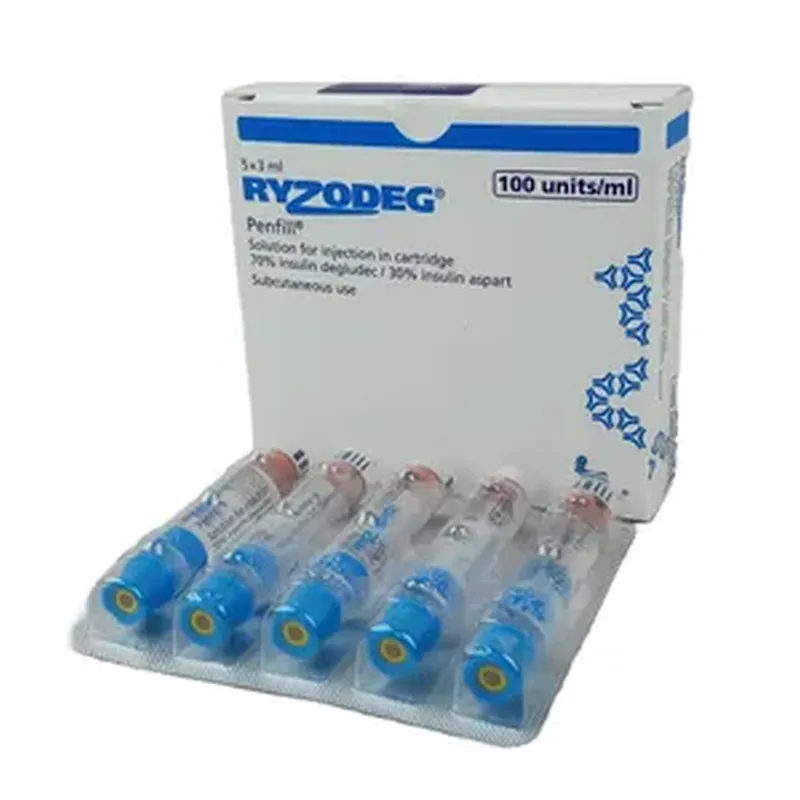
Details description |
|---|
|
Ryzodeg Penfill - Injection
Insulin degludec + Insulin aspart 70/30 premixed - 100IU/ml
1 3ml Cartridge(s) / 3ml Cartridge
Novo Nordisk
Introduction: Ryzodeg Penfill is a combination of two medicines, a long-acting and a rapid-acting type of insulin used to treat types 1 and 2 diabetes mellitus in both adults and children. It provides a steady level of insulin in the body for an entire day and helps control blood sugar levels. Ryzodeg Penfill can be prescribed by itself or along with other diabetes medicines. Your doctor or nurse will teach you the correct way of injecting it under the skin. You should use this medicine regularly as per the dose advised to get the most benefit. It is usually taken once...
Uses of Ryzodeg Penfill: Diabetes mellitus (Type 1 & Type 2)
Side effects of Ryzodeg Penfill: RashWeight gainInjection site allergic reactionLipodystrophy (skin thickening or pits at the injection site)Edema (swelling)ItchingHypoglycemia (low blood glucose level)
How to use Ryzodeg Penfill: Your doctor or nurse will guide you how to use this medicine.
How Ryzodeg Penfill works: Ryzodeg Penfill is a combination of two insulin preparations: Insulin degludec and insulin aspart. Insulin degludec has a prolonged duration of action while insulin aspart has a fast onset of action. Together, they ensure rapid and consistent sugar control by facilitating reuptake of sugar in muscle and fat cells, and suppressing the production of sugar in the liver.
Indication: Treatment of diabetes mellitus in adults.
Administration: Administer subcutaneously in the upper arm, thigh or abdominal wall. A subcutaneous injection into the abdominal wall results in a faster absorption than from other injection sites. Inject SC once or twice daily with any main meal Administer a rapid- or a short-acting insulin at other meals if needed Patients with type 1 diabetes, will generally require a rapid- or short-acting insulin at meals when insulin degludec/insulin aspart 70/30 is not administered for optimal glucose control
Adult Dose: Subcutaneous Prefilled pen Insulin degludec 70 units/insulin aspart 30 units per mL (ie, 100 units/mL for combination) Starting dose in insulin naïve patients Type 1 diabetes mellitus: One third to one half of the total daily insulin dose; as a general rule; the remainder of the total daily insulin dose should be administered as a short- or rapid-acting insulin divided between each daily meal; 0.2-0.4 units/kg can be used to calculate the initial total daily insulin dose in insulin-naïve patients with type 1 diabetes Type 2 diabetes mellitus: 10 units SC once daily Starting dose in patients with types 1...
Child Dose: Safety and efficacy not established
Renal Dose: Renal impairment: Dose adjustments may be needed.
Contraindication: Hypersensitivity to the active substances or to any of the excipients.
Mode of Action: Insulin degludec and insulin aspart binds specifically to the human insulin receptor and results in the same pharmacological effects as human insulin. The blood glucose-lowering effect of insulin is due to the facilitated uptake of glucose following the binding of insulin to receptors on muscle and fat cells and to the simultaneous inhibition of glucose output from the liver.
Precaution: Hypoglycaemia Omission of a meal or unplanned strenuous physical exercise may lead to hypoglycaemia. Hypoglycaemia may occur if the insulin dose is too high in relation to the insulin requirement. Concomitant illness, especially infections and fever, usually increases the patient's insulin requirement. Concomitant diseases in the kidney, liver or diseases affecting the adrenal, pituitary or thyroid gland may require changes in the insulin dose. Hyperglycaemia Administration of rapid-acting insulin is recommended in situations with severe hyperglycaemia. Inadequate dosing and/or discontinuation of treatment in patients requiring insulin may lead to hyperglycaemia and potentially to diabetic ketoacidosis. Furthermore, concomitant illness, especially infections,...
Side Effect: >10% Nasopharyngitis (11.1-24.6%),Severe hypoglycemia (0.4-13.3%) 1-10% Headache (5.6-9.7%),URT infection (5.7-9.1%),Influenza (6.9%),Peripheral edema (1.8-2.2%),Injection site reaction (2%) <1% Allergic reaction,Lipodystrophy
|

No review yet!



LIVE SHOP
(0)
14680 Products
0%
Positive review