 English
 Bangla
 Arabic





















Details description |
|---|
|
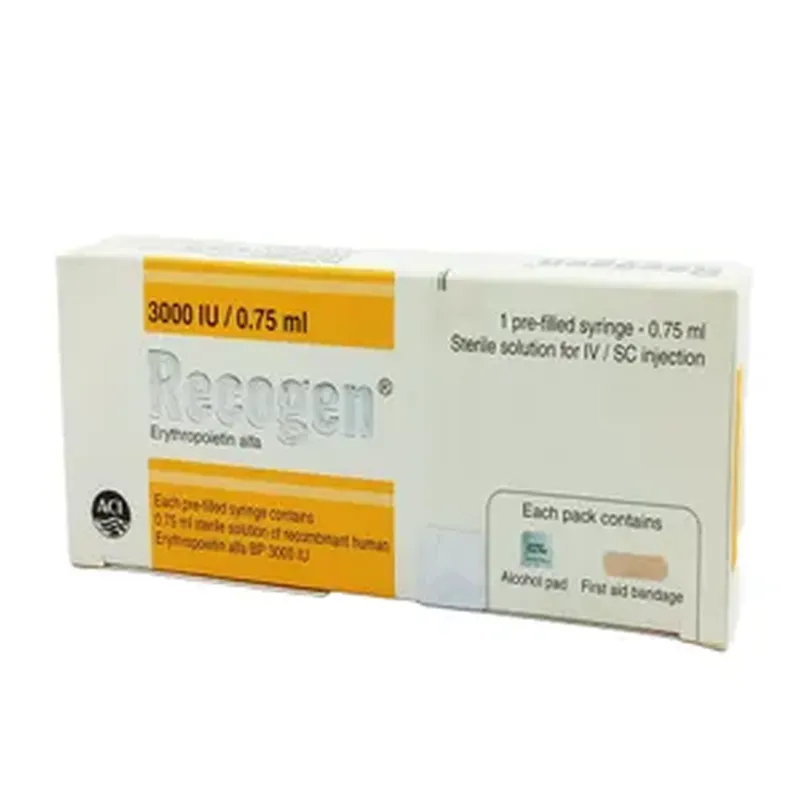
Recogen prefilled syringe 3000 IU - Injection
Erythropoietin - 3000IU/0.75ml
1 Injection(s) / Injection
ACI Limited
Introduction: Recogen prefilled syringe 3000 IU is a medicine that helps your bone marrow to produce more red blood cells. It is used to treat a type of anemia caused by kidney disease. It is also used to treat anemia caused by cancer chemotherapy and by taking medicines to treat HIV. Recogen prefilled syringe 3000 IU is given by injection either under the skin or into a vein which will be decided by your doctor. Usually the injections are given by a nurse or doctor. The dose depends on your body weight and the cause of your anemia. Iron supplements both...
Uses of Recogen prefilled syringe 3000 IU: Anemia due to chronic kidney diseaseAnemia due to cancer chemotherapy
Side effects of Recogen prefilled syringe 3000 IU: High blood pressureNauseaFeverVomiting
How to use Recogen prefilled syringe 3000 IU: Your doctor or nurse will give you this medicine. Kindly do not self administer.
How Recogen prefilled syringe 3000 IU works: Recogen prefilled syringe 3000 IU is an erythropoiesis-stimulating agent (ESA). It works by stimulating the bone marrow (soft tissue inside the bones which produces red blood cells) to produce more red blood cells.
What if you forget to take Recogen prefilled syringe 3000 IU?: If you miss a dose of Recogen prefilled syringe 3000 IU, please consult your doctor.
Indication: Anemia associated with Chronic Renal Failure, including patients on dialysis (ESRD) and patients not on dialysis, Anemia in patients with non-myeloid malignancies where anemia is due to the effect of concomitantly administered chemotherapy, Anemic patients (hemoglobin > 10 to < 13 g/dL) scheduled to undergo elective, noncardiac, nonvascular surgery to reduce the need for allogeneic blood transfusions, Anemia related to therapy with zidovudine in HIV-infected patients.
Adult Dose: Chronic Kidney Disease-Associated Anemia Reduction of need for red blood cell (RBC) transfusion in patients with chronic kidney disease (CKD) Patient not on dialysis: 50-100 units/kg IV/SC 3 times weekly initially Initiate only when (1) hemoglobin level 10 g/dL, reduce or interrupt dose and use lowest dose sufficient to reduce need for RBC transfusion Patient on dialysis: 50-100 units/kg IV 3 times weekly initially Initiate when hemoglobin level 2 months 150 units/kg IV/SC 3 times weekly initially; alternatively, 40,000 units SC once weekly until completion of chemotherapy course Preparation for Surgery With High Risk of Blood Loss Reduction of need...
Child Dose: Chronic Kidney Disease-Associated Anemia 1 month: 50 units/kg IV/SC 3 times weekly initially; if patient on dialysis, IV route recommended Initiate when hemoglobin level <10 g/dL; if hemoglobin level approaches or exceeds 11 g/dL, reduce or interrupt dose Prematurity-Related Anemia 25-100 units/kg SC 3 times weekly or 200-400 units/kg SC/IV q24-48hr for 2-6 weeks Zidovudine-Related Anemia <8 months: Safety and efficacy not established 8 months-17 years: 50-400 units/kg SC/IV 2-3 times weekly Chemotherapy-Related Anemia <5 years: Safety and efficacy not established 5-18 years: 600 units/kg IV once weekly; not to exceed 40,000 units
Contraindication: Uncontrolled hypertension, hypersensitivity to mammalian cell products and human albumin.
Mode of Action: Erythropoietin regulates erythropoiesis by stimulating the differentiation and proliferation of erythroid precursors, stimulating the release of reticulocytes into the circulation, and synthesis of cellular haemoglobin. Recombinant human erythropoietin is available as epoetin alfa and epoetin beta which are used in the management of anaemias associated with CRF, cancer chemotherapy and anti-AIDS drug zidovudine.
Precaution: Erythropoietin should be used with caution in those patients with controlled hypertension, ischaemic vascular disease, history of seizures, or suspected allergy to the product. Iron evaluation: Prior to and during Epoetin therapy, the patient's iron stores, including transferrin saturation and serum ferritin, should be evaluated. Transferrin saturation should be at least 20%, and ferritin should be at least 100 ng/mL. Virtually all patients will require supplemental iron to increase or maintain transferrin saturation to levels that will adequately support erythropoiesis. Lactation: Unknown whether drug is excreted in breast milk; use with caution; avoid administering multidose vials
Side Effect: >10% Pyrexia (10-42%),Nausea (11-35%),Hypertension (14-27%),Cough (4-26%),Vomiting (12-28%),Pruritus (12-21%),Rash (2-19%),Headache (5-18%),Arthralgias (10-16%) 1-10% Arthralgia (10%),Myalgia (10%),Stomatitis (10%),Diarrhea (9%),Dizziness (9%),Edema (9%),Fatigue (9%),Weight decrease (9%),Medical device malfunction (artificial kidney clotting during dialysis) (8%),Vascular occlusion (vascular access thrombosis) (8%),Vomiting (8%),Asthenia (7%),Chest pain (7%),Injection-site irritation (7%),Muscle spasm (7%),Upper respiratory tract infection (URTI) (7%),Urticaria (3%),Seizures (2.5%),Pulmonary embolism (1%),Respiratory tract congestion (1%) Potentially Fatal: Hypertensive crisis with encephalopathy-like symptoms e.g. headache, confusion, generalised seizures. Thrombosis.
Interaction: Haematinics enhance efficiency. Increased dose of heparin in patients undergoing dialysis.
|

No review yet!



LIVE SHOP
(0)
14680 Products
0%
Positive review