English
 Bangla
 Arabic






















Details description |
|---|
|
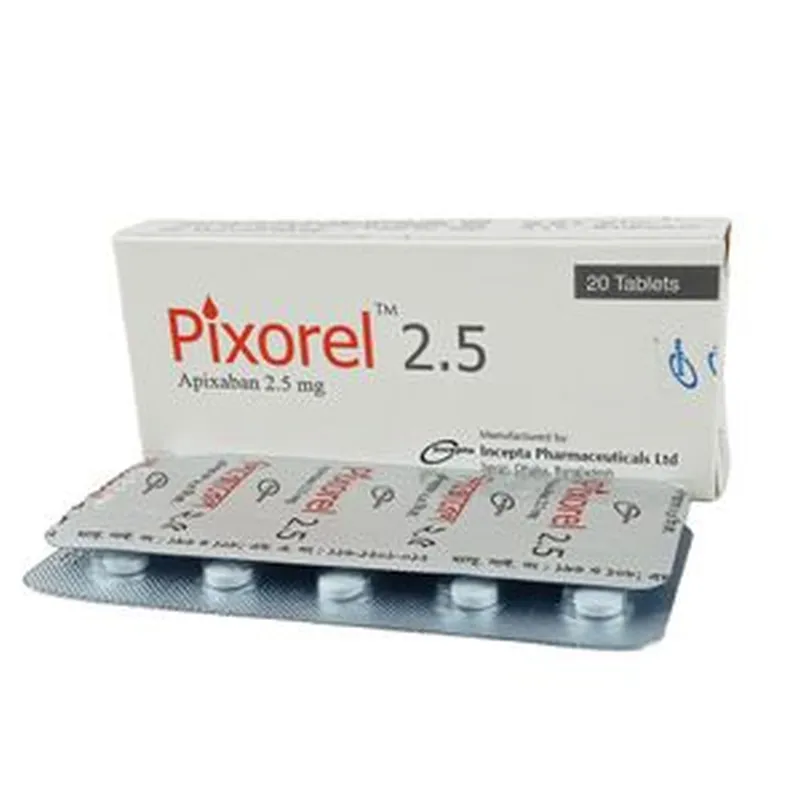
Pixorel 2.5 - Tablet
Apixaban - 2.5mg
10 Tablet(s) / Strip
Incepta Pharmaceuticals Ltd.
Introduction: Pixorel 2.5 is a medicine known as an anticoagulant or blood thinner. It helps prevent and treat blood clots. It is used to reduce the risk of stroke and heart attack. It prevents and treats clot formation in the veins of your legs, lungs, brain and heart. Pixorel 2.5 is commonly used in patients with irregular heart rhythm (atrial fibrillation) to prevent clot formation. It also reduces the risk of getting clots in people who have undergone knee or hip replacement surgeries. It can be taken with or without food and it is best to take them at the same...
Uses of Pixorel 2.5: Deep vein thrombosisPulmonary embolismStroke prevention
How to use Pixorel 2.5: Take this medicine in the dose and duration as advised by your doctor. Swallow it as a whole. Do not chew, crush or break it. Pixorel 2.5 may be taken with or without food, but it is better to take it at a fixed time.
How Pixorel 2.5 works: Pixorel 2.5 is a novel oral anticoagulant (NOAC). It works by preventing the formation of blood clots in the body.
What if you forget to take Pixorel 2.5?: If you miss a dose of Pixorel 2.5, take it as soon as possible. However, if it is almost time for your next dose, skip the missed dose and go back to your regular schedule. Do not double the dose.
Indication: Indicated to reduce risk of stroke and systemic embolism associated with nonvalvular atrial fibrillation, Postoperative Prophylaxis of DVT/PE following hip or knee replacement surgery, Deep venous thrombosis (DVT), Pulmonary embolism (PE),
Administration: May be taken with or without food.
Adult Dose: Oral Adult Prevention of VTE: Elective hip or knee replacement surgery Tablet 2.5 mg twice daily. Initial dose should be taken 12-24 hr post-op. Recommended duration of treatment: Patient undergoing hip replacement surgery 32-38 days. Patient undergoing knee replacement surgery 10-14 days. Prevention of stroke and systemic embolism in non-valvular atrial fibrillation Adult: 5 mg bid. Decrease dose to 2.5 mg PO BID in patients with any 2 of the following characteristics: Age ?80 years Weight ?60 kg Serum creatinine ?1.5 mg/dL Oral Deep vein thrombosis, Pulmonary embolism Adult: 10 mg bid for 7 days, followed by 5 mg bid....
Renal Dose: Renal impairment, including with ESRD on dialysis Deep Vein Thrombosis: No dose adjustment recommended; clinical efficacy and safety studies did not enroll patients with ESRD on dialysis or patients with a CrCl <15 mL/min; dosing recommendations are based on pharmacokinetic and pharmacodynamic (anti-FXa activity) data in study subjects with ESRD maintained on dialysis Renal impairment (nonvalvular atrial fibrillation) Mild-to-moderate: No dosage adjustment required Serum creatinine ?1.5 mg/dL: Decrease dose to 2.5 mg BID if patient has 1 additional characteristic of age ?80 years or weight ?60 kg ESRD maintained on hemodialysis: 5 mg BID; decrease dose to 2.5 mg BID...
Contraindication: Hypersensitivity. Clinically significant active bleeding. Hepatic disease associated w/ coagulopathy & clinically relevant bleeding risk. Lesion or condition at significant risk of major bleeding. Concomitant treatment w/ other anticoagulant agent.
Mode of Action: Apixaban is an anticoagulant that inhibits platelet activation and fibrin clot formation via direct, selective and reversible inhibition of free and clot-bound factor Xa in both intrinsic and extrinsic coagulation pathways. Inhibition of coagulation factor Xa prevents conversion of thrombin and subsequent thrombus formation.
Precaution: Increased risk of hemorrhage eg, congenital or acquired bleeding disorders; active ulcerative GI disease; bacterial endocarditis; thrombocytopenia; platelet disorders; history of haemorrhagic stroke; severe uncontrolled HTN; recent brain, spinal or ophthalmological surgery. Discontinue use if severe haemorrhage occurs. Renal impairment (CrCl <15 mL/min). Contraindicated in patients w/ hepatic disease associated w/ coagulopathy & clinically relevant bleeding risk. Not recommended in patients w/ severe hepatic impairment. Patients w/ mild or moderate hepatic impairment (Child Pugh A or B). Low body wt (<60 kg). Patients receiving concomitant systemic treatment w/ strong inhibitors of both CYP3A4 & P-gp eg, azole antimycotics (eg, ketoconazole,...
Side Effect: Epistaxis, haematoma, anaemia, haematuria, contusion, nausea; GI, rectal or gingival haemorrhage. Potentially Fatal: Epidural or spinal haematoma, fatal bleeding.
Pregnancy Category Note: Pregnancy There are no adequate and well-controlled studies in pregnant women Treatment is likely to increase the risk of hemorrhage during pregnancy and delivery Use of anticoagulants, during pregnancy, may increase risk of bleeding in fetus and neonate Pregnancy confers an increased risk of thromboembolism that is higher for women with underlying thromboembolic disease and certain high-risk pregnancy conditions Published data describe that women with a previous history of venous thrombosis are at high risk for recurrence during pregnancy Therapy should be administered during pregnancy only if the potential benefit outweighs the potential risk to the mother and fetus Animal...
Interaction: Increased exposure w/ strong dual CYP3A4 and P-glycoprotein (P-gp) inhibitors (e.g. clarithromycin, itraconazole, ketoconazole, ritonavir). Increased risk of bleeding w/ drugs affecting haemostasis (e.g. aspirin, heparin, fibrinolytics, SSRIs, NSAIDs, serotonin norepinephrine reuptake inhibitors). Increased risk of stroke w/ strong dual CYP3A4 and P-gp inducers (e.g. rifampicin, phenytoin, carbamazepine).
|

No review yet!



LIVE SHOP
(0)
14680 Products
0%
Positive review