 English
 Bangla
 Arabic






















Details description |
|---|
|
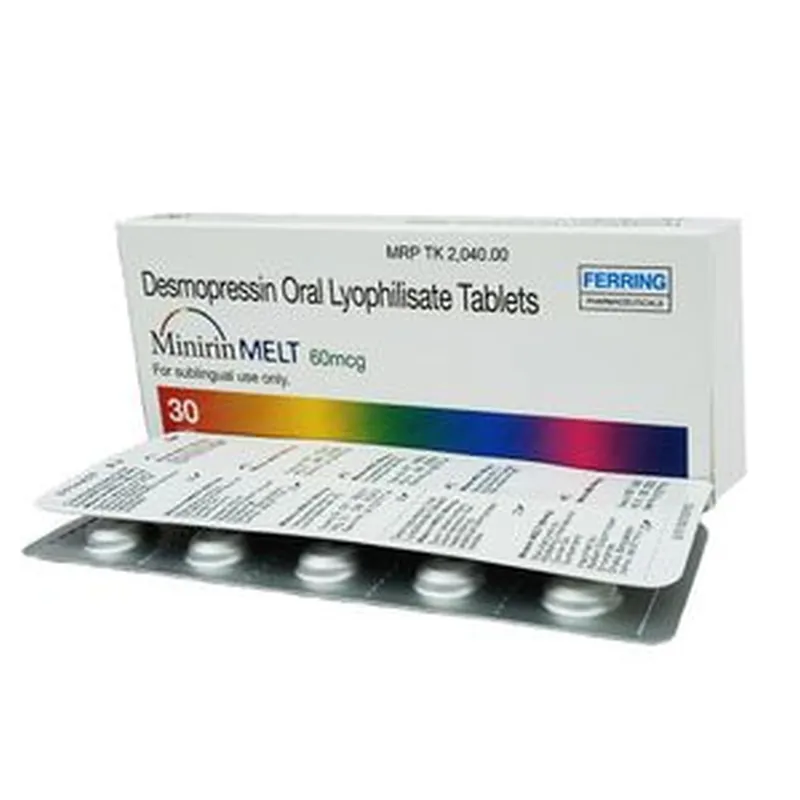
Minirin Melt 60 - Tablet
Desmopressin - 60mcg
10 Tablet(s) / Strip
Radiant Pharmaceuticals Ltd.
Introduction: Minirin Melt 60 is a medicine used in the treatment of diabetes insipidus and bed-wetting. It helps decrease the urge to urinate and help resume more normal life-style. Minirin Melt 60 can be taken in an empty stomach or after food. Your doctor will decide the dose and how often you should take them. You should use it regularly to get the most benefit from the medicine. Do not stop using the medicine even if you feel better unless the doctor tells you so. Some common side effects of this medicine include headache, stomach pain, and nausea. Let your doctor...
Uses of Minirin Melt 60: Diabetes insipidusBed-wetting
Side effects of Minirin Melt 60: HeadacheNausea
How to use Minirin Melt 60: Take this medicine in the dose and duration as advised by your doctor. Swallow it as a whole. Do not chew, crush or break it. Minirin Melt 60 may be taken with or without food, but it is better to take it at a fixed time.
How Minirin Melt 60 works: Minirin Melt 60 is a synthetic form of vasopressin (natural hormone that balances water). It works by causing reabsorption of water from the kidneys which controls excessive thirst and urination in diabetes insipidus. It also helps decrease night-time urine production and bedwetting in children. In addition to these, it reduces bleeding episodes by promoting the release of blood clotting factors.
What if you forget to take Minirin Melt 60?: If you miss a dose of Minirin Melt 60, skip it and continue with your normal schedule. Do not double the dose.
Indication: Diabetes Insipidus, Hemophilia A, Von Willebrand Disease (Type 1), Nocturnal Enuresis, Nocturia, Uremic Bleeding in Acute or Chronic Renal Failure
Administration: May be taken with or without food. IV infusion: Dilute in 10 mL or 50 mL of NaCl 0.9% inj.
Adult Dose: Diabetes Insipidus Intranasal Indicated as antidiuretic replacement therapy in the management of central cranial diabetes insipidus and for management of the temporary polyuria and polydipsia following head trauma or surgery 10-40 mcg (0.1-0.4 mL) qDay, either as a single dose or divided into 2 or 3 doses; usual dose is 20 mcg (0.2 mL) qDay in 2 divided doses Adjust morning and evening doses separately for an adequate diurnal rhythm of water turnover PO Initial: 0.05 mg q12hr Effective range: 0.1-1.2 mg divided q8-12hr Observe fluid restriction If switching to PO from intranasal, start PO at least 12 hours after...
Child Dose: Diabetes Insipidus Nasal spray Indicated as antidiuretic replacement therapy in the management of central cranial diabetes insipidus and for management of the temporary polyuria and polydipsia following head trauma or surgery in the pituitary region in patients (>3 months) 12 years 10-40 mcg (0.1-0.4 mL) qDay, either as a single dose or divided into 2 or 3 doses; usual dose is 20 mcg (0.2 mL) qDay in 2 divided doses Adjust morning and evening doses separately for an adequate diurnal rhythm of water turnover Nocturnal Enuresis >6 years: 0.2 mg PO qHS (up to 0.6 mg/day) Hemophilia A & Von...
Renal Dose: Renal impairment CrCl 50 mL/min: No adjustments necessary
Contraindication: Cardiac insufficiency w/ ongoing diuretic treatment. Patient w/ habitual and psychogenic polydipsia, hyponatraemia or history of hyponatraemia. Moderate to severe renal impairment (CrCl <50 mL/min).
Mode of Action: Desmopressin increases cyclic adenosine monophosphate (cAMP) in renal tubular cells which increases water permeability resulting in reduced urine volume and enhanced urine osmolality. It also stimulates factor VII and plasminogen activator activity in the blood, but w/ minimal pressor activity. Onset: Antidiuretic: Approx 60 min (oral); 15-30 min (intranasal).
Precaution: Patient w/ CV disease or cystic fibrosis, coronary artery insufficiency, at risk for increased intracranial pressure, predisposed to thrombus formation. Elderly and childn. Pregnancy and lactation.
Side Effect: >10% Dry mouth, men (14%) Dry mouth, women (12%) 1-10% Headache (2-5%) Hyponatremia, men (4%) Headache, men (4%) Hyponatremia, women (3%) Dizziness, men (3%) Dizziness (3%) Epistaxis (2-3%) Headache, women (2%) Dizziness, women (2%) Nasal spray Rhinitis (3-8%) Abdominal pain (2%) Asthenia (2%) Chills (2%) Nostril pain (2%) Gastrointestinal disorder (2%) Nausea (2%) Conjunctivitis (2%) Eye edema (2%) Lachrymation disorder (2%) Frequency Not Defined Abnormal blood pressure (infrequent) Increased heart rate Increased blood pressure Flushing Seizure (rare) Hyponatremia Hyposmolality (rare) Water intoxication syndrome Thromboembolic disorder Allergic reaction (acute) Anaphylaxis (rare)
Pregnancy Category Note: Pregnancy Prolonged experience with desmopressin in pregnant women over several decades, based on available published data and case reports, did not identify a drug associated risk of major birth defects, miscarriage or adverse maternal or fetal outcomes; in addition, in vitro studies with human placenta demonstrate poor placental transfer of desmopressin; no adverse developmental outcomes were observed in animal reproduction studies with administration of desmopressin during organogenesis to pregnant rats and rabbits at doses approximately <1 and 38 times, respectively, the maximum recommended human dose based on body surface area (mg/m²) Not recommended for treatment of nocturia in pregnant women;...
Interaction: May enhance antidiuretic effect w/ NSAIDs (e.g. ibuprofen), indometacin, TCAs, chlorpromazine, carbamazepine, SSRIs, opiates, lamotrigine. May reduce antidiuretic effect w/ lithium, epinephrine (large dose), heparin, demeclocycline.
|

No review yet!




LIVE SHOP
(0)
14680 Products
0%
Positive review