 English
 Bangla
 Arabic




















Details description |
|---|
|
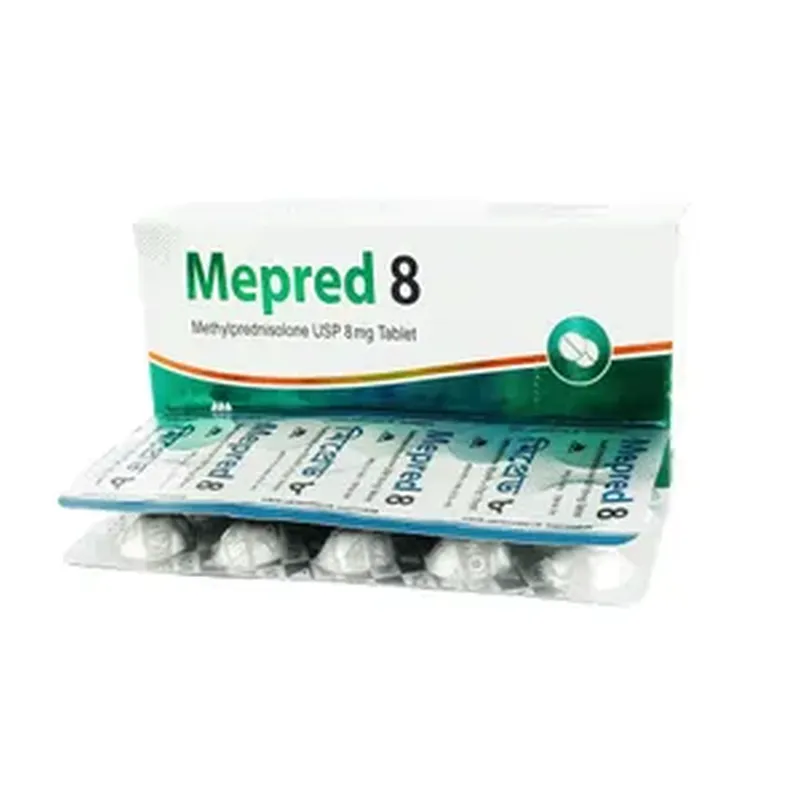
Mepred 8 - tablet
Methylprednisolone - 8mg
10 Tablet(s) / Strip
Albion Laboratories Ltd.
Introduction: Mepred 8 is a medicine used to treat wide variety of medical conditions such as severe conditions, asthma, rheumatic disorder, skin and eye disorders, and nephrotic syndrome. It provides relieve by preventing the release of substances that cause inflammation. Mepred 8 should be taken with food. This will prevent you from getting an upset stomach. The dose and duration will depend on what you are being treated for. You should always take the amount prescribed. Do not take a larger dose or use it more often. Keep taking it regularly even if you feel well. Some conditions will become worse...
Uses of Mepred 8: Rheumatic disorderSkin disordersEye disordersNephrotic syndromeSystemic lupus erythematosus (SLE)
Side effects of Mepred 8: Thinning of skinIncreased risk of infectionReduction in bone densityWeight gainMood changesUpset stomachBehavioural changes
How to use Mepred 8: Take this medicine in the dose and duration as advised by your doctor. Swallow it as a whole. Do not chew, crush or break it. Mepred 8 is to be taken with food. Avoid Mepred 8 with dietary sodium.
How Mepred 8 works: Mepred 8 is a steroid which works by blocking the production of certain chemical messengers in the body that cause inflammation (redness and swelling) and allergies.
Indication: Anti-inflammatory or immunosuppressive, Allergic conditions
Administration: Should be taken with food.
Adult Dose: Oral Anti-inflammatory or immunosuppressive Adult: Initially, 2-60 mg daily in 1-4 divided doses, depending on the disease being treated. Allergic conditions Adult: 24 mg on day 1 (8 mg before breakfast, 4 mg after lunch, 4 mg after supper, and 8 mg at bedtime) or 24 mg as a single or in 2-3 divided doses upon initiation (regardless of time of day); 20 mg on day 2 (4 mg before breakfast, 4 mg after lunch, 4 mg after supper, and 8 mg at bedtime); 16 mg on day 3 (4 mg before breakfast, 4 mg after lunch, 4 mg after...
Child Dose: Oral Anti-inflammatory or immunosuppressive Child: 0.5-1.7 mg/kg daily or 5-25 mg/m2 daily in divided doses 6-12 hrly. Usual dosing range, 0.117-1.66 mg/kg/day PO divided q6-8hr
Contraindication: Systemic fungal infections and known hypersensitivity to components.
Mode of Action: Methylprednisolone is a synthetic corticosteroid with mainly glucocorticoid activity and minimal mineralocorticoid properties. It decreases inflammation by suppression of migration of polymorphonuclear leukocytes and reversal of increased capillary permeability.
Precaution: Patient w/ heart failure, HTN, DM, GI disease (e.g. diverticulitis, intestinal anastomoses, peptic ulcer, ulcerative colitis), multiple sclerosis, myasthenia gravis, acute MI, cataracts, glaucoma, osteoporosis, history of seizure disorder, thyroid disease. Avoid abrupt withdrawal. Renal and hepatic impairment (including cirrhosis). Childn. Pregnancy and lactation. Monitoring Parameters Monitor BP, blood glucose, electrolytes, growth in childn. Lactation: Drug enters milk; use with caution
Side Effect: Adrenal suppression, anaphylactoid reactions, immunosuppression, acute myopathy, Kaposi's sarcoma, psychiatric disturbances (e.g. depression, euphoria, insomnia, mood swings, personality changes), increased susceptibility and severity of infections, impaired healing, HTN, Na and fluid retention, CV collapse (high dose), peptic ulcer, cataract subcapsular, skin atrophy, acne, muscular weakness, growth retardation, decreased blood K; dermal/subdermal skin depression at inj site. Topical: Itching, burning erythema, vesiculation; rarely, folliculitis, hypertrichosis, perioral dermatitis, skin discolouration, allergic skin reactions.
Interaction: Loss of corticosteroid-induced adrenal suppression w/ aminoglutethimide. Risk of hypokalaemia w/ K-depleting agents (e.g. amphotericin B, diuretics). Decreased clearance w/ macrolide antibiotics. May decrease serum levels of isoniazid. Increased clearance w/ cholestyramine. Risk of convulsions w/ ciclosporin. Increased risk of arrhythmias w/ digitalis glycosides. Decreased metabolism w/ oestrogens, including OCs. Enhanced metabolism w/ CYP3A4 inducers (e.g. rifampicin, barbiturates). Increased plasma concentrations w/ CYP3A4 inhibitors (e.g. ketoconazole, erythromycin). Risk of GI effects w/ aspirin or other NSAIDs. May increase the anticoagulant effect of warfarin. May reduce the therapeutic effect of antidiabetics. Potentially Fatal: May diminish response to live or live, attenuated...
|

No review yet!



LIVE SHOP
(0)
14680 Products
0%
Positive review