 English
 Bangla
 Arabic




















Details description |
|---|
|
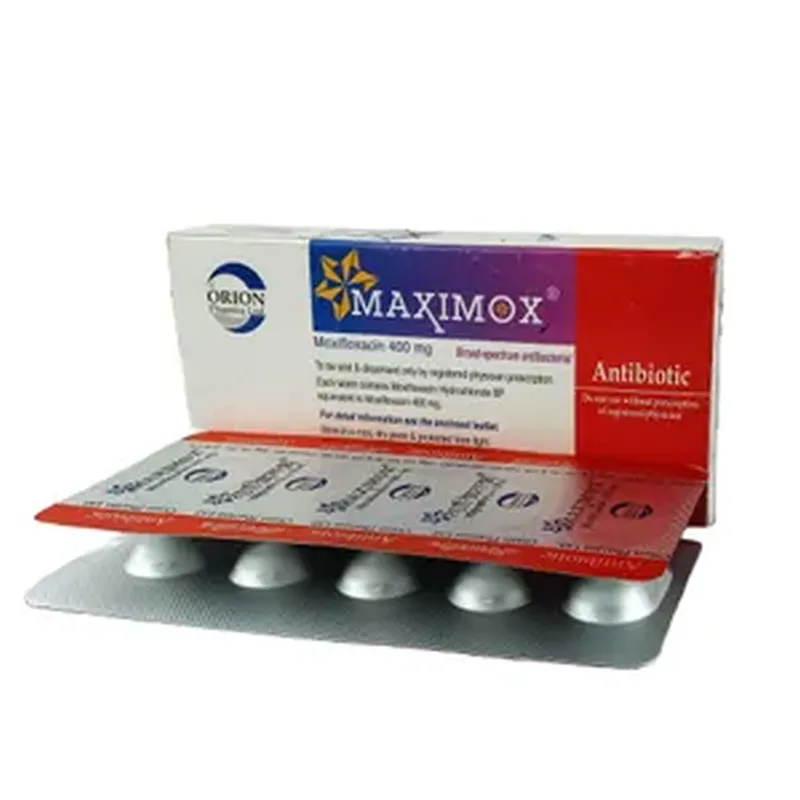
Maximox 400 - Tablet
Moxifloxacin - 400mg
1 Tablet(s) / Tablet
Orion Pharma Ltd.
Introduction: Maximox 400 is an antibiotic, used in the treatment of bacterial infections of the eye. It relieves the symptoms of the infection by stopping the further growth of the causative microorganisms. Maximox 400 is for external use only. Take it in the dose and duration as advised by your doctor. Hold the dropper close to the eye without touching it. Gently squeeze the dropper and place the medicine inside the lower eyelid. Wipe off extra liquid. Avoid skipping any doses and finish the full course of treatment even if you feel better. It may cause eye discomfort, dry eyes and...
Uses of Maximox 400: Bacterial eye infections
Side effects of Maximox 400: Eye discomfortDry eyeBurning sensation
How to use Maximox 400: This medicine is for external use only. Take it in the dose and duration as advised by your doctor. Check the label for directions before use. Hold the dropper close to the eye without touching it. Gently squeeze the dropper and place the medicine inside the lower eyelid. Wipe off extra liquid.
How Maximox 400 works: Maximox 400 is an antibiotic. It treats bacterial eye infections by preventing the bacteria from dividing and repairing. It does so stopping the action of a bacterial enzyme called DNA-gyrase.
What if you forget to take Maximox 400?: If you miss a dose of Maximox 400, take it as soon as possible. However, if it is almost time for your next dose, skip the missed dose and go back to your regular schedule. Do not double the dose.
Indication: Community Acquired Pneumonia, Acute Bacterial Exacerbation of Chronic Bronchitis, Acute Bacterial Sinusitis, Complicated Intra-Abdominal Infection, Uncomplicated Skin and Skin Structure Infections, Complicated Skin and Skin Structure Infections, Typhoid Fever.
Administration: May be taken with or without food.
Adult Dose: Oral The dose of Moxifloxacin is 400 mg once every 24 hours. The duration of therapy depends on the type of infection as described bellow Acute Bacterial Sinusitis 400 mg is given once daily for 10 days. Acute Bacterial Exacerbation of Chronic Bronchitis 400 mg is given once daily for 5 days. Community Acquired Pneumonia 400 mg is given once daily for 7-14 days. Uncomplicated Skin & Skin Structure infections 400 mg is given once daily for 7 days. Complicated Skin & Skin Structure infections 400 mg is given once daily for 7-21 days. Complicated Intra-Abdominal infections 400 mg is...
Child Dose: <18 years: Safety and efficacy not established
Contraindication: Known hypersensitivity to moxifloxacin, other quinolones. Patients w/ known prolongation of QT interval, uncorrected hypokalaemia, myasthenia gravis. Concurrent use of class Ia (e.g.quinidine, procainamide, class III (e.g. amiodarone, sotalol) antiarrhythmic drugs or w/ other drugs that prolong QT interval (e.g. erythromycin, TCAs, antipsychotic agents).
Mode of Action: Moxifloxacin inhibits the topoisomerase II (DNA gyrase) and topoisomerase IV required for bacterial DNA replication, transcription, repair and recombination.
Precaution: Maintain adequate fluid intake; Patient w/ previous tendon disorders (e.g. rheumatoid arthritis), significant bradycardia or acute myocardial ischaemia, heart failure w/ reduced LVEF, known history of symptomatic arrhythmias, known or suspected CNS disorders (e.g. severe cerebral arteriosclerosis, epilepsy) or other risk factors that predispose to seizures; diabetes. Kidney, heart or lung transplant recipients. Hepatic impairment. Pregnancy and lactation. Patient Counselling This drug may cause dizziness and lightheadedness, if affected do not drive or operate machinery. Rest and refrain from doing strenuous physical activity as it may increase risk of tendon rupture. Avoid exposure to sunlight or artificial UV light (e.g....
Side Effect: 1-10% Nausea (7%),Diarrhea (6%),Dizziness (3%),Decreased amylase (2%),Decreased basophils, eosinophils, hemoglobin, prothrombin time, red blood cells, neutrophils (2%),Decreased serum glucose (2%),Increased serum chloride (2%),Increased serum ionized calcium (2%),Immune hypersensitivity reaction (0.1-2%),Prolonged QT interval (0.1-2%) <1% Acute renal failure,Agranulocytosis,Anaphylactoid reaction,Aplastic anemia,Extrinsic allergic alveolitis,Hemolytic anemia,Hepatic failure,Hepatic necrosis,Hepatitis,Pancytopenia,Seizure,Serum sickness due to drug,Stevens-Johnson syndrome,Tendon rupture, tendinitis,Thrombocytopenia,Torsades de pointes,Toxic epidermal necrolysis
Interaction: Additive effect on QT interval prolongation w/ other drugs that prolong QT interval (e.g. erythromycin, TCAs, antipsychotic agents). Decreased absorption and bioavailability w/ Al- or Mg-containing antacids, or Fe or Zn preparations. Concomitant use of corticosteroids increases the risk of severe tendon disorders esp in elderly (>60 yr). Decreased absorption w/ sucralfate or didanosine. Potentially Fatal: Concurrent use of class Ia (e.g. quinidine, procainamide) or III (e.g. amiodarone, sotalol) antiarrhythmic drugs or w/ other drugs that prolong QT interval (e.g. erythromycin, TCAs, antipsychotic agents) may cause additive effect on QT interval prolongation.
|

No review yet!



LIVE SHOP
(0)
14680 Products
0%
Positive review