English
 Bangla
 Arabic






















Details description |
|---|
|
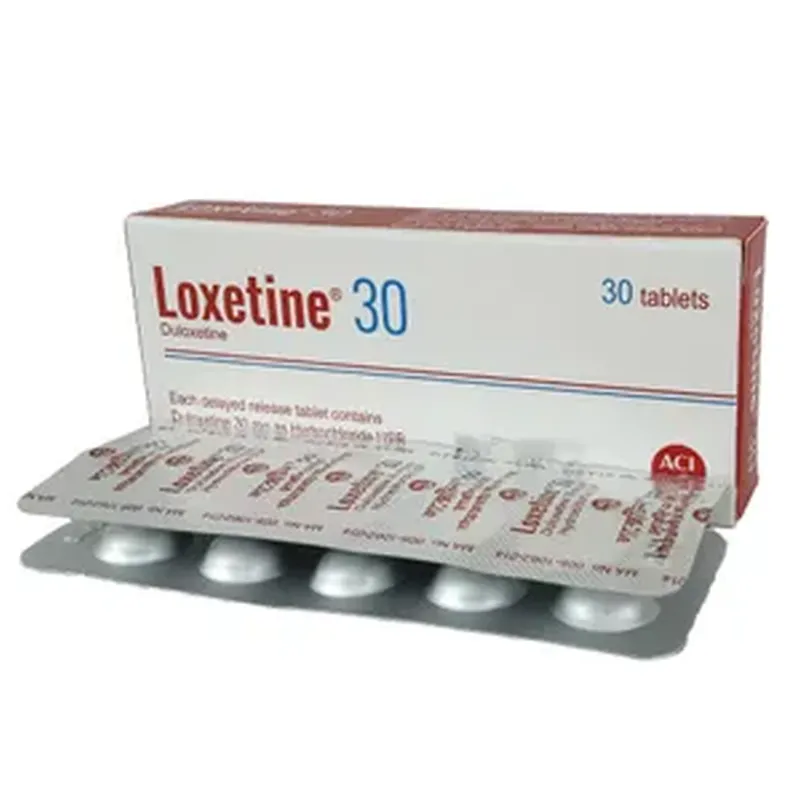
Loxetine 30 - Tablet
Duloxetine - 30mg
10 Tablet(s) / Strip
ACI Limited
Introduction: Loxetine 30 is a prescription medicine used in the treatment of depression, anxiety disorder, diabetic nerve pain, fibromyalgia (a condition in which there are generalized pain and tenderness in the body), neuropathic pain and stress urinary incontinence. Loxetine 30 works by increasing the level of chemical messengers (serotonin and noradrenaline) in the brain that have a calming effect on the brain and relax the nerves, thus treating your illness. It may be taken with or without food. It is advised to take this medicine at a fixed time each day to maintain a consistent level in the blood. If you...
Uses of Loxetine 30: DepressionAnxiety disorderDiabetic nerve painFibromyalgiaNeuropathic painStress urinary incontinence
Side effects of Loxetine 30: NauseaHeadacheDryness in mouthSleepinessDizziness
How to use Loxetine 30: Take this medicine in the dose and duration as advised by your doctor. Swallow it as a whole. Do not chew, crush or break it. Loxetine 30 may be taken with or without food, but it is better to take it at a fixed time.
How Loxetine 30 works: Loxetine 30 works by increasing the levels of chemical messengers (serotonin and noradrenaline), natural substances in the brain that help maintain mental balance and stop the movement of pain signals in the brain.
What if you forget to take Loxetine 30?: If you miss a dose of Loxetine 30, take it as soon as possible. However, if it is almost time for your next dose, skip the missed dose and go back to your regular schedule. Do not double the dose.
Indication: Major Depressive Disorder (MDD), Fibromyalgia, Diabetic neuropathy, Stress urinary incontinence, Generalized anxiety disorder, Interstitial cystitis, Musculoskeletal pain
Administration: May be taken with or without food. Swallow whole, do not chew/crush.
Adult Dose: Oral Major Depressive Disorder Adult: Initially, 20-30 mg bid or 60 mg once daily, then increase dose in increments of 30 mg/day over 1 wk as tolerated. Max: 120 mg/day. Diabetic Peripheral Neuropathic Pain Adult: 60 mg once daily. Max: 120 mg/day in divided doses. Generalized Anxiety Disorder Adult: 30 or 60 mg once daily. Max: 120 mg/day. Fibromyalgia Adult: Initially, 30 mg once daily for 1 wk, then increase to 60 mg once daily. Elderly Major Depressive Disorder May initiate at 20 mg PO qDay or divided BID; increase to 40-60 mg qDay or divided doses; alternatively, initiate at...
Child Dose: Generalized Anxiety Disorder 60 mg/day; if increased beyond 60 mg/day, use increments of 30 mg/day Maximum dose studied was 120 mg/day; safety of doses >120 mg/day has not been evaluated
Renal Dose: Renal Impairment Avoid use in patients with severe renal impairment (GFR <30 mL/min)
Contraindication: Duloxetine is contraindicated in patients with a known hypersensitivity to this drug or any of the inactive ingredients.. Uncontrolled narrow-angle glaucoma. Concomitant use or within 2 wk of MAOIs. Renal and hepatic impairment.
Mode of Action: Duloxetine is a potent inhibitor of neuronal reuptake of serotonin, norepinephrine and to a lesser extent dopamine. It has no significant affinity for adrenergic, muscarinic, cholinergic, histaminergic, opioid, glutamate and GABA receptors. It also does not inhibit monoamine oxidase.
Precaution: Avoid alcohol and abrupt cessation. May impair ability to drive or engage in task requiring alertness. Increased risk of suicidal thinking and behaviour when used in children and adolescents. Pregnancy, lactation. Lactation: Drug enters breast milk; use not recommended unless benefits greatly outweigh risks
Side Effect: >10% Nausea (23-25%),Dry mouth (13-15%),Headache (13-14%),Somnolence (10-12%),Fatigue (10-11%) 1-10% Constipation (10%),Dizziness (10%),Insomnia (10%),Diarrhea (9-10%),Anorexia (8%),Decreased appetite (7-8%),Abdominal pain (6%),Hyperhidrosis (6%),Increased sweating (6%),Agitation (5%),Nasopharyngitis (5%),Vomiting (3-5%),Male sexual dysfunction (2-5%),Abdominal pain (4%),Decreased libido (4%),Musculoskeletal pain (4%),Upper respiratory tract infection (URTI) (4%),Abnormal orgasm (3%),Agitation (3%),Anxiety (3%),Blurred vision (3%),Cough (3%),Influenza (3%),Muscle spasms (3%),Tremor (3%),Abnormal dreams (2%),Dyspepsia (2%),Hot flushes (2%),Nausea (2%),Oropharyngeal pain (2%),Palpitations (2%),Paresthesia (2%),Weight loss (2%),Yawning (2%),Dysuria (>1%),Gastritis (>1%),Rash (>1%)
Pregnancy Category Note: Pregnancy There are no adequate and well-controlled studies administration in pregnant women Use in pregnancy only if the potential benefit justifies the potential risk to the fetus Clinical considerations Neonates exposed during pregnancy to serotonin - norepinephrine reuptake inhibitors (SNRIs) or selective serotonin reuptake inhibitors (SSRIs) have developed complications requiring prolonged hospitalization, respiratory support, and tube feeding which can arise immediately upon delivery Reported clinical findings have included respiratory distress, cyanosis, apnea, seizures, temperature instability, feeding difficulty, vomiting, hypoglycemia, hypotonia, hypertonia, hyperreflexia, tremor, jitteriness, irritability, and constant crying These features are consistent with either a direct toxic effect of the...
Interaction: Increased risk of serotonin syndrome w/ TCA, SSRI, SNRI, lithium. May increase bleeding risk w/ aspirin, NSAIDs, warfarin and other anticoagulants. Potentially Fatal: Increased risk of serotonin syndrome w/ MAOIs, linezolid and methylene blue. Increased serum levels and risk of toxicity w/ potent CYP1A2 inhibitors (e.g. ciprofloxacin, enoxacin).
|

No review yet!





LIVE SHOP
(0)
14680 Products
0%
Positive review