English
 Bangla
 Arabic





















Details description |
|---|
|
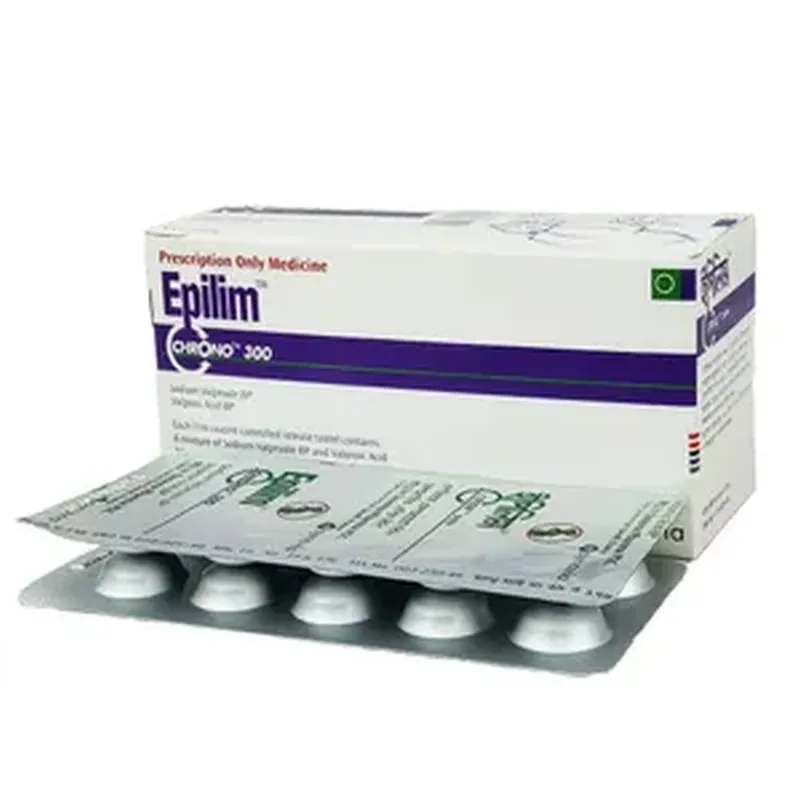
Epilim 300 - Tablet
Sodium Valproate (valproic acid) - 300mg
10 Tablet(s) / Strip
Synovia Pharma PLC.
Introduction: Epilim 300 is a combination of two medicines used to treat epilepsy, a neurological disorder in which there are recurrent episodes of seizures or fits. It controls the abnormal activity of the brain, relaxes the nerves and hence, prevents seizures or fits. Epilim 300 should be taken with food. Your doctor will decide the correct dose for you. This may increase gradually until your condition is stable. This medicine may take several weeks to work but it is important to take it regularly to get the benefit. Do not stop taking it, even if you feel fine unless your doctor...
Uses of Epilim 300: Epilepsy
Side effects of Epilim 300: NauseaVomitingWeight gainLoss of appetiteGum swellingHeadacheSleepinessTremorHair lossLiver injury
How to use Epilim 300: Take this medicine in the dose and duration as advised by your doctor. Swallow it as a whole. Do not chew, crush or break it. Epilim 300 is to be taken with food.
How Epilim 300 works: Epilim 300 is a combination of two antiepileptic medicines: Sodium Valproate and Valproic Acid. They work together to control seizures or fits by decreasing the abnormal and excessive activity of the nerve cells in the brain.
Indication: Epilepsy, e.g. Partial seizures, Absence seizures (petit mal), Generalized tonic-clonic seizures (grand mal), Myoclonic seizures, Atonic seizures, Mixed seizures, Anxiety disorder, Posttraumatic stress disorder, Febrile convulsion, Anorexia nervosa, Panic attack, Migraine, bipolar disorder.
Adult Dose: Oral Complex Partial Seizures Indicated as monotherapy and adjunctive therapy for complex partial seizures that occur either in isolation or in association with other types of seizures PO: 10-15 mg/kg/day initially; increase by 5-10 mg/kg/day at weekly intervals; may increase dose up to 60 mg/kg/day Simple & Complex Absence Seizures Also indicated for use as sole and adjunctive therapy in the treatment of simple and complex absence seizures, and adjunctively in patients with multiple seizure types that include absence seizures PO: 15 mg/kg/day initially, divided q6-12hr; increase by 5-10 mg/kg/day at weekly intervals; may increase dose up to 60 mg/kg/day...
Child Dose: 10 years 250 mg PO q12hr; adjust dose based on clinical response up to 1000 mg/day
Renal Dose: Renal impairment No adjustment necessary
Contraindication: Preexisting or family history of hepatic dysfunction, active liver disease, porphyria; mitochondrial and urea cycle disorders. Hepatic impairment. Pregnancy.
Mode of Action: Valproate is a generic term used to describe valproic acid, its salts and derivatives. It is available in various forms including the sodium salts (valproate semisodium and sodium valproate), the amide derivative (valpromide), or as valproic acid. Valproate is a carboxylic acid anticonvulsant. It has been suggested that its antiepileptic activity is related to increased brain levels of ?-aminobutyric acid (GABA).
Precaution: Increased risk of hepatotoxicity in childn <2 yr, congenital metabolic disorders, organic brain disease or severe seizure disorders. HIV or cytomegalovirus (CMV) infection; SLE. Decrease dose or discontinue in patients w/ excessive somnolence, decreased food or fluid intake. Gradual withdrawal or transition to and from another type of antiepileptic therapy. Suspect hyperammonemic encephalopathy and measure ammonia levels in patients who develop unexplained lethargy, vomiting or changes in mental status. Immobilised patients or those who have insufficient sun exposure or calcium intake should consider vitamin supplementation. Decrease GI side effects by taking w/ meals, starting w/ low dose or taking the...
Side Effect: >10% Nausea (31%),Headache (<31%),Increased bleeding time (26-30%),Thrombocytopenia (26-30%),Tremor (25%),Alopecia (<24%),Asthenia (16-20%),Infection (16-20%),Somnolence (16-20%),Amblyopia (11-15%),Diarrhea (11-15%),Diplopia (11-15%),Dizziness (11-15%),Dyspepsia (11-15%),Nystagmus (11-15%),Tinnitus (11-15%),Vomiting (11-15%) 1-10% Ataxia (<8%),Increased appetite (<6%),Rash (<6%),Abdominal pain (<5%),Tremor (<5%),Back pain (<5%),Mood changes (<5%),Anxiety (<5%),Confusion (<5%),Abnormal gait (<5%),Paresthesia (<5%),Hallucinations (<5%),Catatonia (<5%),Dysarthria (<5%),Tardive dyskinesia (<5%),Vertigo (<5%),Irregular menses (<5%),Weight gain (4%) Frequency Not Defined Anorexia,Acute pancreatitis (may be life-threatening),Hepatic toxicity,Hyperammonemia,Weight loss,Fractures,Osteoporosis,Osteopenia,Decreased bone mineral density,Cerebral pseudoatrophy
Interaction: Increased risk of toxicity w/ bupropion. Increased risk of convulsions w/ mefloquine. Increased risk of carnitine deficiency w/ pivmecillinam and pivampicillin. Increased risk of hepatotoxicity and carbamazepine toxicity w/ a decrease in valproic acid levels w/ concurrent carbamazepine. Decreased valproic acid and increased ethosuximide serum levels w/ ethosuximide. Decreased valproic acid levels w/ carbapenems, rifampicin, phenytoin, phenobarbital (or primidone) and antineoplastic drug regimens. Increased valproic acid levels w/ felbamate and aspirin. Increased risk of hepatotoxicity w/ olanzepine. Concurrent use increased phenobarbital, nimodipine, nifedipine, lamotrigine, zidovudine, amitriptyline, nortriptyline and benzodiazepines levels. Concurrent use decreased tigabine and clozapine levels. Increased risk of...
|

No review yet!




LIVE SHOP
(0)
14680 Products
0%
Positive review