English
 Bangla
 Arabic






















Details description |
|---|
|
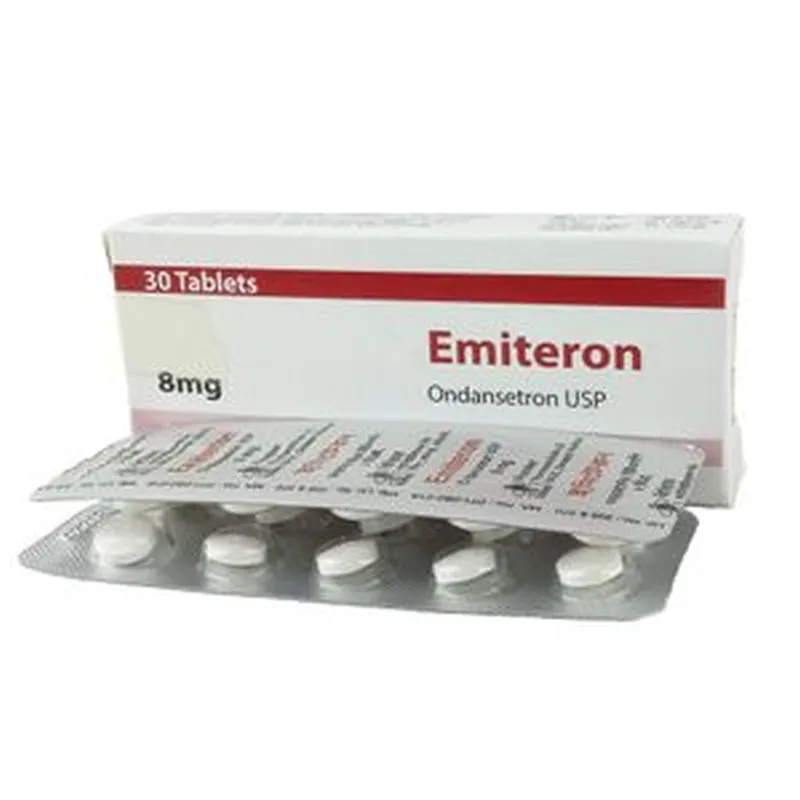
Emiteron 8 - Tablet
Ondansetron - 8mg
10 Tablet(s) / Strip
Premier Pharmaceuticals
Introduction: Emiteron 8 is an antiemetic medicine commonly used to control nausea and vomiting due to certain medical conditions like stomach upset. It is also used to prevent nausea and vomiting caused due to any surgery, cancer drug therapy or radiotherapy. Emiteron 8 may be used alone or with other medications and can be taken with or without food. Your doctor will suggest the appropriate dose depending on what you are taking it for. The first dose is normally taken before the start of surgery, chemotherapy or radiotherapy. After these treatments, take any further doses as prescribed by your doctor (normally...
Uses of Emiteron 8: NauseaVomiting
Side effects of Emiteron 8: ConstipationDiarrheaFatigueHeadache
How to use Emiteron 8: Take this medicine in the dose and duration as advised by your doctor. Do not handle the tablets with wet hands. Put it in your mouth but do not swallow it. Emiteron 8 may be taken with or without food, but it is better to take it at a fixed time.
How Emiteron 8 works: Emiteron 8 is an antiemetic medication. It works by blocking the action of a chemical messenger (serotonin) in the brain that may cause nausea and vomiting during anti-cancer treatment (chemotherapy) or after surgery.
What if you forget to take Emiteron 8?: If you miss a dose of Emiteron 8, take it as soon as possible. However, if it is almost time for your next dose, skip the missed dose and go back to your regular schedule. Do not double the dose.
Indication: Prevention of nausea-vomiting associated with chemotherapy, Prevention of nausea & vomiting associated with radiotherapy, Prevention of post-operative nausea & vomiting, Nausea-vomiting in gastroenteritis, Nausea vomiting in pregnancy
Administration: May be taken with or without food. Reconstitution: Prior to IV infusion, dilute in 50 mL dextrose 5% inj or normal saline.
Adult Dose: Oral Adult: Prevention of nausea & vomiting associated with chemotherapy: Highly emetogenic chemotherapy: 24 mg once 30 minutes before start of single-day chemotherapy. Moderately emetogenic chemotherapy: 8 mg (one 8 mg tablet) administered 30 minutes before start of emetogenic chemotherapy. A further 8 mg dose should be administered after 8 hours of the first dose. One 8 mg tablet should be administered twice a day (every 12 hours) for 1-2 days after completion of chemotherapy. Prevention of nausea & vomiting associated with radiotherapy: Total body irradiation: 8 mg 1-2 hours before each fraction of radiotherapy administered each day. Single high-dose...
Child Dose: Oral Moderate emetogenic cancer chemotherapy: Child (4-11 years): 4 mg tablet should be taken 30 minutes before the start of chemotherapy. The other 2 doses should be taken 4 and 8 hours after the first dose. Then 4 mg tablet should be administered 3 times a day (every 8 hours) for 1-2 days after completion of chemotherapy. Prevention of nausea & vomiting associated with radiotherapy: Child >12 years Total body irradiation: 8 mg 1-2 hours before each fraction of radiotherapy administered each day. Single high-dose fraction radiotherapy to abdomen: 8 mg 1-2 hours before radiotherapy, then 8 mg every 8...
Renal Dose: Renal impairment: Dose adjustment not necessary
Contraindication: Use with apomorphine (profound hypotension).
Mode of Action: Ondansetron antagonises selective 5-HT3-receptor, blocking serotonin, both peripherally on vagal nerve terminals and centrally in the chemoreceptor trigger zone. This action of ondansetron gives it its antiemetic property to prevent emesis due to acute chemotherapy mediated by serotonin.
Precaution: May mask progressive ileus and/or gastric distension. Severe hepatic impairment. Pregnancy and lactation. Monitoring Parameters ECG monitoring of patients w/ electrolytes abnormalities e.g. hypomagnesaemia or hypokalaemia, CHF or bradyarrhythmias and on medication that can prolong QT interval.
Side Effect: >10% Headache (9-27%),Malaise/fatigue (9-13%),Constipation (6-11%) 1-10% Hypoxia (9%),Drowsiness (8%),Diarrhea (2-7%),Dizziness (7%),Fever (2-8%),Gynecologic disorder (7%),Anxiety (6%),Urinary retention (5%),Pruritus (2-5%),Injection-site pain (4%),Paresthesia (2%),Cold sensation (2%),Elevated liver function test results (1-5%) <1% Cardiac: Arrhythmias (including ventricular and supraventricular tachycardia, premature ventricular contractions, and atrial fibrillation), bradycardia, electrocardiographic alterations (including second-degree heart block, QT/QTc interval prolongation, and ST segment depression), palpitations, and syncope; rarely and predominantly with intravenous ondansetron, transient ECG changes including QT/QTc interval prolongation have been reported Gastrointestinal: Nausea and vomiting Anaphylaxis ECG alterations: Arrhythmias; prolongation of PR, QRS, and QT intervals Hepatobiliary: Specific hepatic enzyme abnormalities, hepatic necrosis, and abnormal hepatic...
Interaction: May reduce analgesic effect of tramadol. Rifampicin and other CYP3A4 inducers may reduce levels/effects of ondansetron. Concomitant use of QT-prolonging agents (e.g. antiarrhythmics) may cause additive prolongation of QT interval. May increase the risk of arrhythmias w/ cardiotoxic drugs (e.g. anthracyclines). Potentially Fatal: May increase the hypotensive effect of apomorphine.
|

No review yet!




LIVE SHOP
(0)
14680 Products
0%
Positive review