English
 Bangla
 Arabic






















Details description |
|---|
|
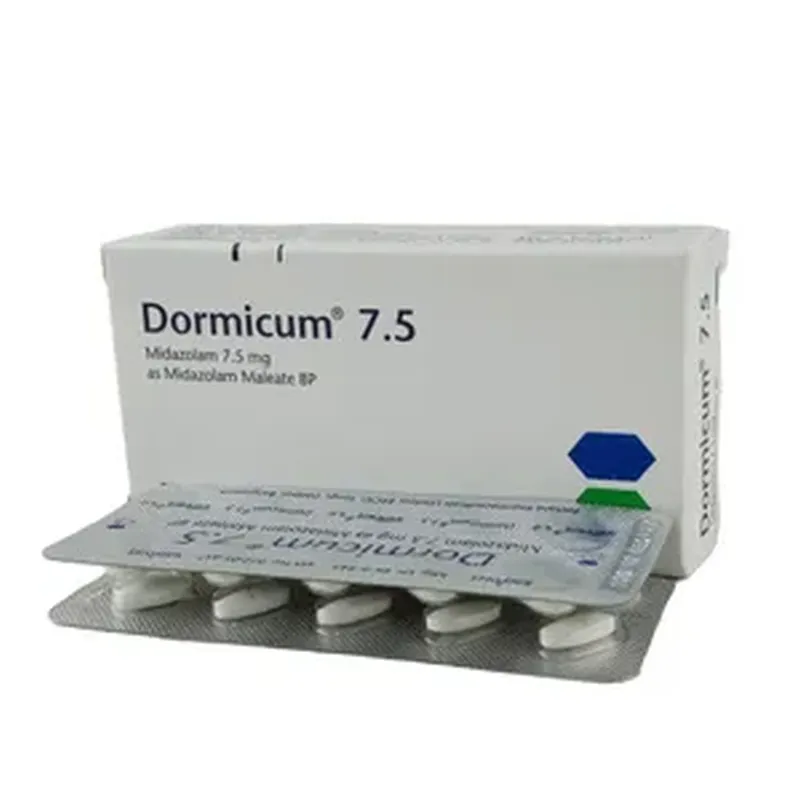
Dormicum 7.5 - Tablet
Midazolam - 7.5mg
10 Tablet(s) / Strip
Radiant Pharmaceuticals Ltd.
Introduction: Dormicum 7.5 is a prescription medicine used as a sedative or for conscious sedation before diagnostic or therapeutic procedures. It relieves anxiety and muscle tensions, thus making the person comfortable before investigations or minor surgical or dental procedures. Dormicum 7.5 reduces anxiety and causes drowsiness. It comes in the form of a nasal spray and taken under the supervision of a healthcare professional only or can be used after the proper guidance of a doctor. Take this medicine in the dose and duration as advised by your doctor as it has a high potential of habit-forming. If you have missed...
Uses of Dormicum 7.5: Conscious sedation during diagnostic or therapeutic procedures
Side effects of Dormicum 7.5: Nasal discomfortThroat irritation
How to use Dormicum 7.5: Use this medicine in the dose and duration as advised by your doctor. Check the label for directions before use. Insert the bottle tip into one nostril and close the other nostril. Direct the spray towards the sides of your nostril, away from the cartilage dividing the two sides of your nose. As you spray, breath gently and keep the head upright. Repeat the same process for the other nostrils.
How Dormicum 7.5 works: Dormicum 7.5 is a benzodiazepine (BZD). It is rapidly absorbed into the bloodstream through the inner lining of the nose. Once absorbed, it works by increasing the action of GABA, a chemical messenger which suppresses the abnormal and excessive activity of the nerve cells in the brain. This helps the patient to recover from a seizure faster.
What if you forget to take Dormicum 7.5?: If you miss a dose of Dormicum 7.5, take it as soon as possible. However, if it is almost time for your next dose, skip the missed dose and go back to your regular schedule. Do not double the dose.
Indication: Short-term treatment of insomnia. Sedation in premedication before surgical or diagnostic procedures.
Administration: May be taken with or without food. Midazolam IV should be administered very slowly.
Adult Dose: Adult Oral Short-term management of insomnia Adult: 7.5-15 mg at bedtime. Elderly: 7.5 mg at bedtime. Hepatic impairment: Mild to moderate: Dosage reduction needed. Severe: Contraindicated. Parenteral Preoperative Sedation IM Adult: 0.07-0.1 mg/kg bodyweight i. m. Usual dose is about 5 mg. Elderly and debilitated patients: 0.025-0.05 mg/kg IV Endoscopic or Cardiovascular Procedures In healthy adults the initial dose is approximately 2.5 mg. In cases of severe illness and in elderly patients, the initial dose must be reduced to 1 to 1.5 mg. Induction of Anesthesia The dose is 10-15 mg I. V.
Child Dose: Oral Seizures Child: 3-6 mth Hospital setting: 2.5 mg; >6 mth to <1 yr 2.5 mg; 1-<5 yr 5 mg; 5-<10 yr 7.5 mg; 10-<18 yr 10 mg. Doses are given as single dose. Sedation 500-750 mcg/kg PO once diluted by juice 20-30 minutes prior to procedure; not to exceed 20 mg Rectal administration in children: For preoperative sedation, rectal administration of the ampoule solution (0.35-0.45 mg/kg) 20-30 min before induction of general anesthesia. Parenteral Sedation IM 100-150 mcg/kg IM; up to 500 mcg/kg used; not to exceed 10 mg IV <6 months: Initial, 50 mcg/kg IV over 2-3 minutes;...
Contraindication: Severe resp failure or acute resp depression, acute narrow-angle glaucoma, myasthenia gravis, sleep apnoea syndrome; severe hepatic impairment (oral). Concomitant use w/ potent CYP3A4 inhibitors.
Mode of Action: Midazolam is a short-acting benzodiazepine. It exerts sedative and hypnotic, muscle relaxant, anxiolytic and anticonvulsant actions. While the probable anxiolytic action might be as a result of the drug's ability to increase glycine inhibitory neurotransmitter level, the hypnotic/anaesthetic action may be due to the occupation of the benzodiazepine and GABA receptors leading to membrane hyperpolarisation and neuronal inhibition, and further interfering with the re-uptake of GABA at the synapses.
Precaution: Patients w/ heart failure, impaired gag reflex, resp disease, history of alcohol or drug abuse. Patient at risk of falls. Hepatic and renal impairment. Childn, elderly and debilitated patient. Pregnancy and lactation. Avoid abrupt withdrawal after prolonged use. Avoid rapid inj in neonates. Patient Counselling May impair ability to drive or operate machinery. Monitoring Parameters Monitor resp and CV status, BP. Lactation: Distributed in breast milk, use caution
Side Effect: >10% Decreased respiratory rate (23%),Apnea (15%) 1-10% Drowsiness (1-5%),Seizure-like activity (1%),Nausea/vomiting (3%),Cough (1%),Pain at injection site (4-5%) Frequency Not Defined Headache,Sedation,Hiccoughs,Delirium,Euphoria Pediatric Desaturation,Hypotension,Seizurelike activity,Nystagmus,Paradoxical reactions,Hiccoughs,Apnea
Pregnancy Category Note: Midazolam should be avoided during pregnancy unless there is no safer alternative. Since Midazolam passes into breast milk, it should not be administered to breast-feeding mothers.
Interaction: Increased CNS depression with alcohol, opioids, barbiturates, other sedatives and anaesthetics. Increased respiratory depression with opiates, phenobarbital, other benzodiazepines. Plasma concentrations increased by CYP3A4 inhibitors such as cimetidine, erythromycin, clarithromycin, diltiazem, verapamil, ketoconazole and itraconazole, antiretroviral agents, quinupristin with dalfopristin. Midazolam concentration decreased by phenytoin, carbamazepine, phenobarbital, rifampicin. Halothane, thiopental requirements may be reduced during concurrent use.
|

No review yet!




LIVE SHOP
(0)
14680 Products
0%
Positive review