 English
 Bangla
 Arabic




















Details description |
|---|
|
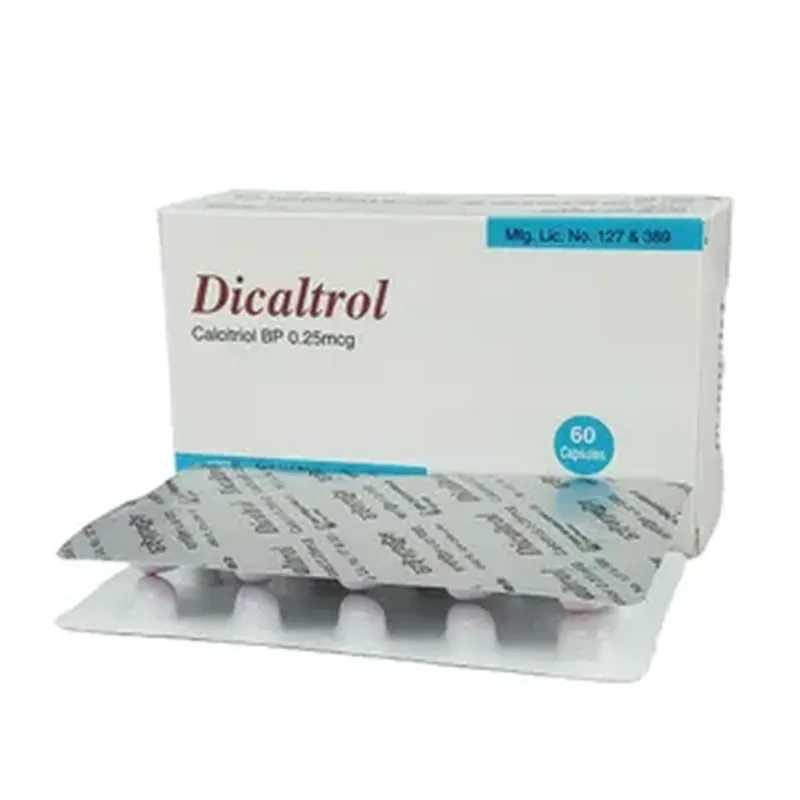
Dicaltrol 0.25 - Capsule
Calcitriol - 0.25mcg
15 Capsule(s) / Strip
Drug International Ltd.
Introduction: Dicaltrol 0.25 is the active form of Vitamin D. It increases the levels of Vitamin D in your blood which in turn raises calcium levels in the blood by helping in absorption of more calcium from your intestine. Thus, it is used in the treatment of calcium deficiency and postmenopausal osteoporosis. Dicaltrol 0.25 is given in women after menopause to strengthen weak bones. It helps in reducing the bone damage. It is administered as an injection. It is advised not to self administer the injection, it should be done by a healthcare professional. In case of injection site reactions such...
Uses of Dicaltrol 0.25: Calcium deficiency
Side effects of Dicaltrol 0.25: Injection site reactions (pain, swelling, redness)
How to use Dicaltrol 0.25: Your doctor or nurse will give you this medicine. Kindly do not self administer.
How Dicaltrol 0.25 works: Dicaltrol 0.25 is the active form of Vitamin D. It raises Vitamin D levels in your blood. This in turn raises calcium levels in your blood by helping you absorb more calcium from your intestine.
Indication: Osteoporosis, Hypoparathyroidism, Hypocalcaemia, Osteomalacia rickets, Renal osteodystrophy, Chronic kidney dialysis.
Administration: May be taken with or without food. May be taken w/ meals to reduce GI discomfort.
Adult Dose: Adult: Capsule: The optimal daily dose of Calcitriol must be carefully determined for each patient on the basis of the serum calcium level. Calcitriol can be administered orally either 0.25 mcg or 0.50 mcg. Postmenopausal osteoporosis The recommended dosage is 0.25 mcg twice daily or 0.50 mcg once daily. Serum creatinine levels should be determined at 4 weeks, 3 and 6 months and 6 monthly intervals thereafter. Renal osteodystrophy (Dialysis patients) The recommended initial dose of Calcitriol is 0.25 mcg/day. Patients with normal or only slightly reduced serum calcium levels may respond to Calcitriol doses of 0.25 mcg every other...
Child Dose: Chronic Renal Dialysis Associated Hypocalcemia 0.25-2 mcg/day PO qDay Hypoparathyroidism/Pseudohypoparathyroidism 6 years: 0.5-2 mcg PO qDay Familial Hypophosphatemia Initial: 0.015-0.02 mcg/kg PO qDay Maintenance: 0.03-0.06 mcg/kg PO qDay No more than 2 mcg PO qDay Secondary Hyperparathyroidism in Moderate to Severe Kidney Disease 3 years: 0.25 mcg/day PO; may increase to 0.5 mcg/day Hypocalcemia in Premature Infants 1 mcg qDay PO for 5 days
Contraindication: Hypercalcaemia; evidence of vitamin D toxicity. Pregnancy (dose exceeding RDA). Lactation.
Mode of Action: Calcitriol promotes calcium absorption in the intestines and retention at the kidneys thus increasing serum calcium levels. It also increases renal tubule phosphate resorption consequently decreasing serum phosphatase levels, PTH levels and bone resorption..
Precaution: Idiopathic hypercalcaemia. Pediatric doses must be individualised and monitored under close medical supervision. Coronary disease, renal function impairment and arteriosclerosis, especially in the elderly. Hypoparathyroidism. Excessive dosage of Calcitriol induces hypercalcemia and in some instances hypercalciuria; therefore, early in treatment during dosage adjustment, serum calcium should be determined twice weekly. Patients with normal renal function who are taking Calcitriol should avoid dehydration. Adequate fluid intake should be maintained. Lactation: Enters breast milk; not recommended
Side Effect: Abdominal pain,Apathy,BUN and creatinine increased,Cardiac arrhythmia,Constipation,Dry mouth,Dehydration,Growth suppression,Headache,Hyperthermia,Hypercalcemia,Hypercholesteremia,Hypermagnesemia,Hyperphosphatemia,Hypertension,Libido decreased,Metallic taste,Muscle or bone pain,Nocturia,Pruritus,Psychosis,Somnolence,Weakness
Pregnancy Category Note: Pregnancy category: C Lactation: Enters breast milk; not recommended
Interaction: Hypermagnesaemia may develop in patients on chronic renal dialysis. Hypercalcaemia in patients on digitalis may precipitate cardiac arrhythmias. Intestinal absorption of calcitriol may be reduced by cholestyramine and colestipol. Phenytoin, barbiturates may decrease the T1/2 of calcitriol. May develop hypercalcaemia with thiazide diuretics.
|

No review yet!




LIVE SHOP
(0)
14680 Products
0%
Positive review