English
 Bangla
 Arabic






















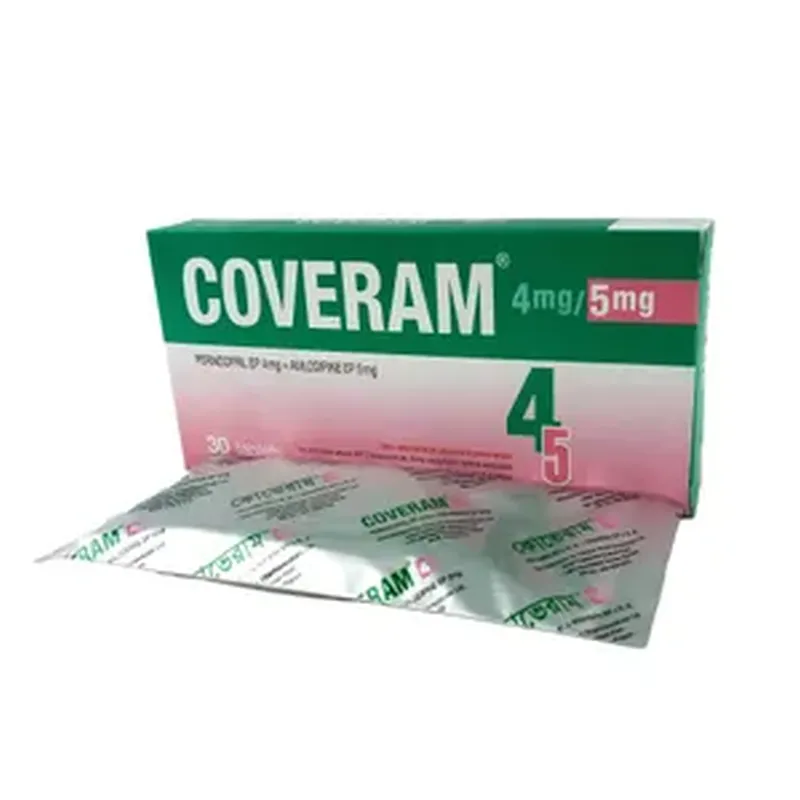
Details description |
|---|
|
Coveram 4/5 - tablet
Perindopril + Amlodipine - 4mg+5mg
30 Tablet(s) / Box
Servier Bangladesh Operation
Introduction: Coveram 4/5 is used to treat hypertension (high blood pressure). This is a combination of two medicines that controls blood pressure when a single medication is not effective. It helps to lower high blood pressure and thus reduces the chances of future heart attack and stroke. You can take Coveram 4/5 at any time of day, on empty stomach, but it is best to take it at the same time each day. Keep taking it for as long as advised by your doctor. Even if you feel well, do not stop this medicine on your own because high blood pressure...
Uses of Coveram 4/5: Hypertension (high blood pressure)
Side effects of Coveram 4/5: Ankle swellingHeadacheTirednessPalpitationsIncreased potassium level in bloodSleepinessCoughTaste changeFlushing (sense of warmth in the face, ears, neck and trunk)Decreased blood pressureUpset stomach
How to use Coveram 4/5: Take this medicine in the dose and duration as advised by your doctor. Swallow it as a whole. Do not chew, crush or break it. Coveram 4/5 is to be taken empty stomach.
How Coveram 4/5 works: Coveram 4/5 is a combination of two medicines: Amlodipine and perindopril which lower blood pressure effectively. It works by relaxing blood vessels so that blood flows more smoothly and the heart can pump blood more efficiently.
Indication: Indicated for the treatment of hypertension in patients whose blood pressure is not adequately controlled on monotherapy or as initial therapy in patients likely to need multiple drugs to achieve blood pressure goals
Administration: Should be taken on an empty stomach.
Adult Dose: Hypertension Indicated for the treatment of hypertension in patients whose blood pressure is not adequately controlled on monotherapy or as initial therapy in patients likely to need multiple drugs to achieve blood pressure goals Tablet 4 mg/5 mg PO qDay with or without food Adjust dose according to blood pressure goals; wait 7-14 days between titration steps Not to exceed 14 mg/10 mg qDay Hepatic impairment: There are no data to guide dosing recommendations
Renal Dose: Renal Impairment CrCl <30 mL/min: Not recommended CrCl 30-80 mL/min (mild or moderate renal impairment): Do not exceed 7/5 mg
Contraindication: History of idiopathic angioedema. Severe hypotension, shock (e.g. cardiogenic shock), left ventricular outflow tract obstruction (e.g. high grade aortic stenosis), heart failure after acute MI. Pregnancy and lactation. Concomitant use w/ aliskiren esp in patients w/ DM or renal impairment (GFR <30 mL/min/1.73 m2).
Mode of Action: Perindopril, a prodrug of perindoprilat, is an ACE inhibitor which prevents convertion of angiotensin I to angiotensin II, thereby increasing plasma renin activity and decreasing vasoconstriction and aldosterone secretion. Amlodipine, a dihydropyridine Ca channel blocker, inhibits transmembrane influx of Ca ions into vascular smooth muscle and cardiac muscle thereby causing relaxation and vasodilation. It also directly acts on vascular smooth muscle causing reductions in peripheral vascular resistance and BP.
Precaution: Patient w/ salt or volume depletion, severe obstructive coronary artery disease, renal artery and mitral and severe aortic stenosis, ischemic heart disease or cerebrovascular disease, hypertrophic cardiomyopathy w/ outflow tract obstruction, cardiac failure, collagen vascular disease. Hepatic and renal impairment. Elderly. Patient undergoing major surgery or during anaesthesia; desensitisation treatment (e.g. hymenoptera venom). Lactation: Unknown if distributed in human breast milk; because of the potential for adverse effects on the nursing infant, decide whether to discontinue nursing or discontinue the drug
Side Effect: 1-10% Peripheral edema (7.2%) Cough (3.2%) Headache (2.5%) Dizziness (2.5%) Frequency Not Defined Dermatologic: Rash Digestive: Nausea, diarrhea
Interaction: Increased hypotensive effects w/ antihypertensive agents (e.g. β-blockers), diuretics, and vasodilators. May increase serum levels and toxicity of lithium. May cause nitritoid reactions w/ Na aurothiomalate. Increased risk of angioneurotic oedema w/ estramustine. May increase hypoglycaemic effect w/ insulin or sulfonamides. Increased antihypertensive effect and risk of orthostatic hypotension w/ TCAs, antipsychotics, anaesthetics, α-blockers. May increase risk of angioedema w/ mammalian target of rapamycin (mTOR) inhibitors (e.g. sirolimus, everolimus, temsirolimus). May cause worsening of renal function and loss of antihypertensive effect w/ NSAIDs. Decreased antihypertensive effects w/ NSAIDs and sympathomimetics.
|

No review yet!



LIVE SHOP
(0)
14680 Products
0%
Positive review