English
 Bangla
 Arabic





















Details description |
|---|
|
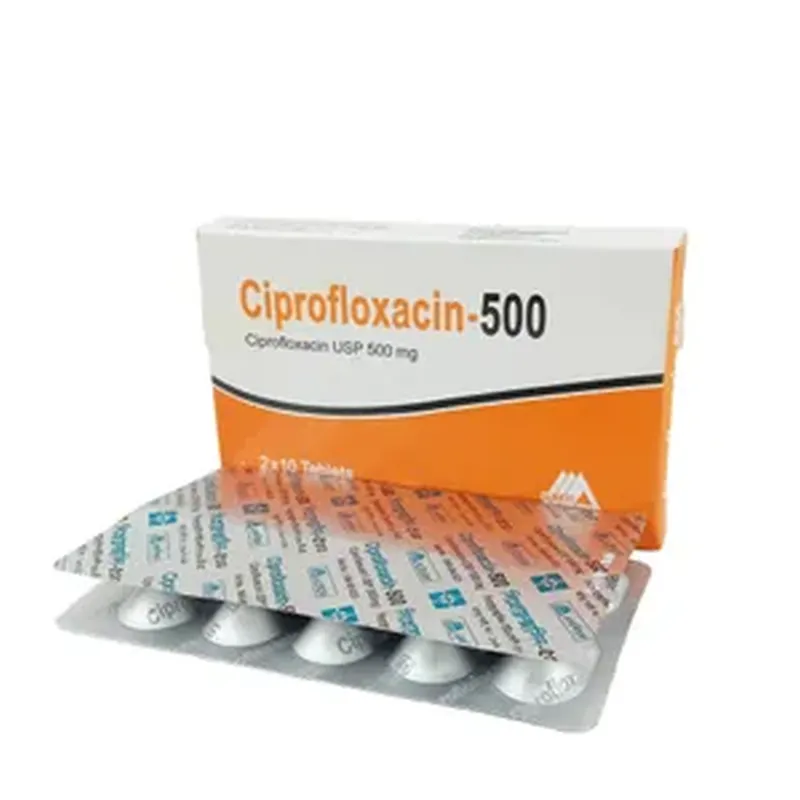
Ciprofloxacin 500 - Tablet
Ciprofloxacin - 500mg
10 Tablet(s) / Strip
Albion Laboratories Ltd.
Introduction: Ciprofloxacin 500 is an antibiotic, used in the treatment of bacterial infections. It is also used in treating infections of the urinary tract, nose, throat, skin and soft tissues and lungs (pneumonia). It cures the infection by stopping the further growth of the causative microorganisms. Ciprofloxacin 500 should be used in the dose and duration as advised by your doctor. It may be taken with or without food, preferably at a fixed time. Avoid skipping any doses and finish the full course of treatment even if you feel better. Do not take a double dose to make up for a...
Uses of Ciprofloxacin 500: Bacterial infections
Side effects of Ciprofloxacin 500: NauseaDiarrhea
How to use Ciprofloxacin 500: Take this medicine in the dose and duration as advised by your doctor. Swallow it as a whole. Do not chew, crush or break it. Ciprofloxacin 500 may be taken with or without food, but it is better to take it at a fixed time. Avoid Ciprofloxacin 500 with caffeine and chocolate as well as food containing caffeine and chocolate such as tea leaves, cocoa beans.
How Ciprofloxacin 500 works: Ciprofloxacin 500 is an antibiotic. It works by stopping the action of a bacterial enzyme called DNA-gyrase. This prevents the bacterial cells from dividing and repairing, thereby killing them.
What if you forget to take Ciprofloxacin 500?: If you miss a dose of Ciprofloxacin 500, take it as soon as possible. However, if it is almost time for your next dose, skip the missed dose and go back to your regular schedule. Do not double the dose.
Indication: Cystic fibrosis, Intra-abdominal infections, Meningitis, Peritonitis, Endocarditis, Anthrax, Otitis media, Septicaemia, Lower Respiratory Tract Infections, Cystitis, Gonorrhoea, Skin and skin structure infections, Nosocomial pneumonia, Urinary tract infections, Enteric fever, Bone and Joint Infections, Biliary tract infections, Surgical Prophylaxis, Gastroenteritis, Q fever, Acute Sinusitis, Cat scratch disease, Spotted fever, Typhus, Chanroid, Brucellosis, Typhoid and paratyphoid fever, Superficial ophthalmic infections, Otitis externa
Administration: May be taken with or without food. May be taken w/ meals to minimise GI discomfort. Do not take w/ antacids, Fe or dairy products. IV Administration Infuse 1-2 mg/mL (diluted in D5W or NS) into large vein over 60 minutes
Adult Dose: Oral Adult Dose: For oral dosage & suspension: Urinary Tract infection: Acute uncomplicated: 250 mg twice daily for 3 days; Mild/Moderate: 250 mg twice daily for 7 to 14 days; Severe/Complicated: 500 mg twice daily for 7 to 14 days; Chronic Bacterial Prostitis : 500 mg twice daily for 28 days; Lower Respiratory Tract infection: Mild/Moderate: 500 mg twice daily for 7 to 14 days, Severe/Complicated : 750 mg twice daily for 7 to 14 days; Acute Sinusitis : 500 mg twice daily for 10 days; Skin and Skin Structure infection: Mild/Moderate : 500 mg twice daily for 7 to...
Child Dose: Child Dose: PO 20–40 mg/kg/day, max 1.5 g/day q12h. IV 20–30 mg/kg/day, max 1.2 g/day q12h. Children and adolescents: RTI & GI infections: Neonate-15mg/kg twice daily, Child (1 month -18 years)-20mg/kg (max 750 mg) twice daily; UTI: Neonate-10 mg/kg twice daily, Child (1 month -18 years)-10mg/kg (max 750 mg) twice daily; Pseudomonal lower respiratory tract infection in cystic fibrosis: Child (1 month -18 years) - 20mg/kg (max 750 mg) twice daily; Anthrax (treatment & post exposure prophylaxis): Child (1 month -18 years) - 20mg/kg (max 750 mg) twice daily.
Renal Dose: Renal impairment CrCl >50 mL/min: Dose adjustment not necessary CrCl 30-50 mL/min: 250-500 mg PO q12hr CrCl <30 mL/min: Extended-release, 500 mg PO q24hr CrCl 5-29 mL/min: 250-500 mg PO q18hr or 200-400 mg IV q18-24hr Some clinicians suggest decreasing dose but not frequency of administration Hemodialysis: 0.25-0.5 g PO q12hr or 0.2-0.4 g IV q24hr Peritoneal dialysis: 0.25-0.5 g PO q8hr or 0.2-0.4 g IV q24hr
Contraindication: Hypersensitivity. Not to be used concurrently with tizanidine. Avoid exposure to strong sunlight or sun lamps during treatment.
Mode of Action: Ciprofloxacin promotes breakage of double-stranded DNA in susceptible organisms and inhibits DNA gyrase, which is essential in reproduction of bacterial DNA.
Precaution: Epilepsy, history of CNS disorders; severe renal or hepatic dysfunction; G6PD deficiency; maintain adequate hydration; myasthaenia gravis. Caution when used in patients with QT prolongation or risk factors e.g. bradycardia, pre-existing cardiac disease or uncorrected electrolyte disturbances. Discontinue treatment if patients experience tendon pain, inflammation or rupture. Avoid usage in methicillin-resistant staphylococcus aureus (MRSA) infections due to high level of resistance. May impair ability to drive or operate machinery. Safety and efficacy have not been established in pregnant and lactating women. Not to be used in children <18 yr; except where benefit clearly exceeds risk. Lactation: Drug enters breast milk;...
Side Effect: 1-10% Nausea (3%),Abdominal pain (2%),Diarrhea (2% adults; 5% children),Increased aminotransferase levels (2%),Vomiting (1% adults; 5% children),Headache (1%),Increased serum creatinine (1%),Rash (2%),Restlessness (1%) <1% Acidosis,Allergic reaction,Angina pectoris,Anorexia,Arthralgia,Ataxia,Back pain,Bad taste,Blurred vision,Breast pain,Bronchospasm,Diplopia,Dizziness,Drowsiness,Dysphagia,Dyspnea,Flushing,Foot pain,Hallucinations,Hiccups,Hypertension,Hypotension,Insomnia,Irritability,Joint stiffness,Lethargy,Migraine,Nephritis,Nightmares,Oral candidiasis,Palpitation,Photosensitivity,Polyuria,Syncope,Tachycardia,Tinnitus,Tremor,Urinary retention,Vaginitis Potentially Fatal: Anaphylactoid reaction; cardiopulmonary arrest.
Pregnancy Category Note: Pregnancy category: C Lactation: Drug enters breast milk; use not recommended (American Academy of Pediatrics Committee states that drug is compatible with nursing)
Interaction: May increase plasma concentrations of CYP1A2 substrates (e.g. clozapine, ropinirole, theophylline). Enhances effect of oral anticoagulants (e.g. warfarin) and glibenclamide. Increased toxicity of methotrexate. Plasma concentrations may be increased by probenecid. Reduced absorption w/ oral multivitamins and mineral supplements containing divalent or trivalent cations (e.g. Fe, Zn, Ca) and antacids containing Al, Ca or Mg. Concomitant use w/ class IA antiarrhythmics (e.g. quinidine, procainamide), class III antiarrhythmics (e.g. amiodarone, sotalol), TCAs, macrolides and antipsychotics may result in additive effects on QT interval prolongation. Concurrent use w/ corticosteroids may increase risk of severe tendon disorders. Increased risk of CNS stimulation w/...
|

No review yet!




LIVE SHOP
(0)
14680 Products
0%
Positive review