 English
 Bangla
 Arabic





















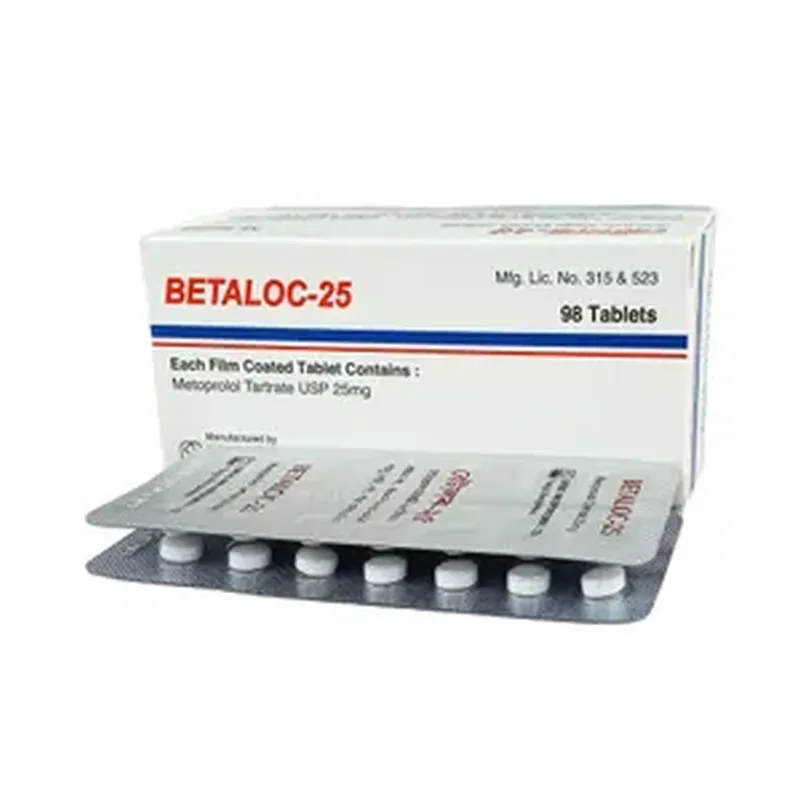
Details description |
|---|
|
Betaloc 25 - Tablet
Metoprolol Tartrate - 25mg
14 Tablet(s) / Strip
Drug International Ltd.
Introduction: Betaloc 25 belongs to a group of medicines called beta-blockers. It is used to treat high blood pressure (hypertension), angina (heart-related chest pain), irregular heart rhythms (arrhythmia). It also helps to prevent future heart attacks and stroke and to prevent migraine. Betaloc 25 is also used to relieve the symptoms caused by an overactive thyroid gland. It may be prescribed alone or together with other medications. The dose and frequency depend on what you are taking it for and the severity of your condition. It may be taken empty stomach or with a meal, but take it regularly at the...
Uses of Betaloc 25: Hypertension (high blood pressure)Angina (heart-related chest pain)Arrhythmia
Side effects of Betaloc 25: Orthostatic hypotension (sudden lowering of blood pressure on standing)Slow heart rateHeadacheDizzinessTirednessStomach painNauseaBreathlessness
How to use Betaloc 25: Take this medicine in the dose and duration as advised by your doctor. Swallow it as a whole. Do not chew, crush or break it. Betaloc 25 is to be taken with food.
How Betaloc 25 works: Betaloc 25 is a short-acting beta blocker that works specifically on the heart. It works by slowing down the heart rate and makes the heart more efficient at pumping blood around the body.
Indication: Heart failure, Migraine, Acute MI, Diabetic nephropathy, Hypertension, Cardiac arrhythmias, Angina pectoris
Administration: May be taken with or without food.
Adult Dose: Oral Hypertension Adult: Conventional tab: Initially, 100 mg/day in single or 2 divided doses, may increase wkly to 400 mg/day depending on response. Maintenance: 100-200 mg/day. Extended-release tab: Initially, 25-100 mg once daily. Angina pectoris Adult: Conventional tab: 50-100 mg bid or tid. Extended release tab: 100 mg once daily. Max: 200 mg once daily. Cardiac arrhythmias Adult: 50 mg bid or tid, may increase to 300 mg/day in divided doses if needed. Adjunct in hyperthyroidism Adult: 25-50 mg 4 times/day. Prophylaxis of migraine Adult: Conventional tab: 100-200 mg/day in divided doses. Extended release tab: 100 mg once daily. Stable...
Child Dose: Oral Hypertension Conventional tab: 1-17 years: 1-2 mg/kg/day PO divided BID; not to exceed 6 mg/kg/day or ?200 mg/day Extended-release tab: >6 years: 1 mg/kg PO qDay; not to exceed 50 mg/day initially; adjusted on basis of patient response; not to exceed 2 mg/kg/day or <200 mg/day
Renal Dose: Renal impairment: No dosage adjustment needed.
Contraindication: 2nd or 3rd degree AV block, sick sinus syndrome, hypotension, decompensated heart failure, sinus bradycardia, severe peripheral arterial circulatory disorders, cardiogenic shock, severe asthma and bronchospasm, untreated phaeochromocytoma, Prinzmetal's angina, metabolic acidosis.
Mode of Action: Metoprolol selectively inhibits beta1-adrenergic receptors but has little or no effect on beta2-receptors except in high doses. It does not exhibit membrane stabilising or intrinsic sympathomimetic activity.
Precaution: Patients w/ myasthenia gravis, well-compensated heart failure, bronchospastic disease, AV conduction disorders, substantial cardiomegaly. May mask signs and symptoms of hyperthyroidism and hypoglycaemia. Patients w/ history of cardiac failure or those w/ minimal cardiac reserve. Patients undergoing major surgery involving general anaesth. Avoid abrupt withdrawal as it may precipitate thyroid storm or MI, and may exacerbate angina and ventricular arrhythmias. Hepatic impairment. Pregnancy and lactation. Patient Counselling May affect ability to drive or operate machinery. Monitoring Parameters Monitor BP, ECG and heart rate. Lactation: Drug is concentrated in breast milk; use with caution (American Academy of Pediatrics states that drug...
Side Effect: 1-10% Dizziness (10%),Headache (10%),Tiredness (10%),Depression (5%),Diarrhea (5%),.Pruritus (5%),Bradycardia (9%),Rash (5%),Dyspnea (1-3%),Cold extremities (1%),Constipation (1%),Dyspepsia (1%),Heart failure (1%),Hypotension (1%),Nausea (1%),Flatulence (1%),Heartburn (1%),Xerostomia (1%),Wheezing (1%),Bronchospasm (1%) Frequency Not Defined Decreased exercise tolerance,Raynaud phenomenon,Increased triglyceride levels and insulin resistance, decreased high-density lipoprotein (HDL) levels
Interaction: Additive effect w/ catecholamine-depleting drugs (e.g. reserpine) and MAOIs. May antagonise ?1-adrenergic stimulating effects of sympathomimetics. Additive negative effects on SA or AV nodal conduction w/ cardiac glycosides, nondihydropyridine Ca channel blockers. Paradoxical response to epinephrine may occur. Increased plasma concentrations w/ CYP2D6 inhibitors (e.g. bupropion, cimetidine). Increased risk of hypotension and heart failure w/ myocardial depressant general anaesth (e.g. diethyl ether). Risk of pulmonary HTN w/ vasodilators (e.g. hydralazine) in uraemic patients. Reduced plasma levels w/ rifampicin. May increase negative inotropic and negative dromotropic effect of antiarrhythmic drugs (e.g. quinidine, amiodarone). May reduce antihypertensive efficacy w/ indometacin. May increase...
|

No review yet!



LIVE SHOP
(0)
14680 Products
0%
Positive review