 English
 Bangla
 Arabic




















Details description |
|---|
|
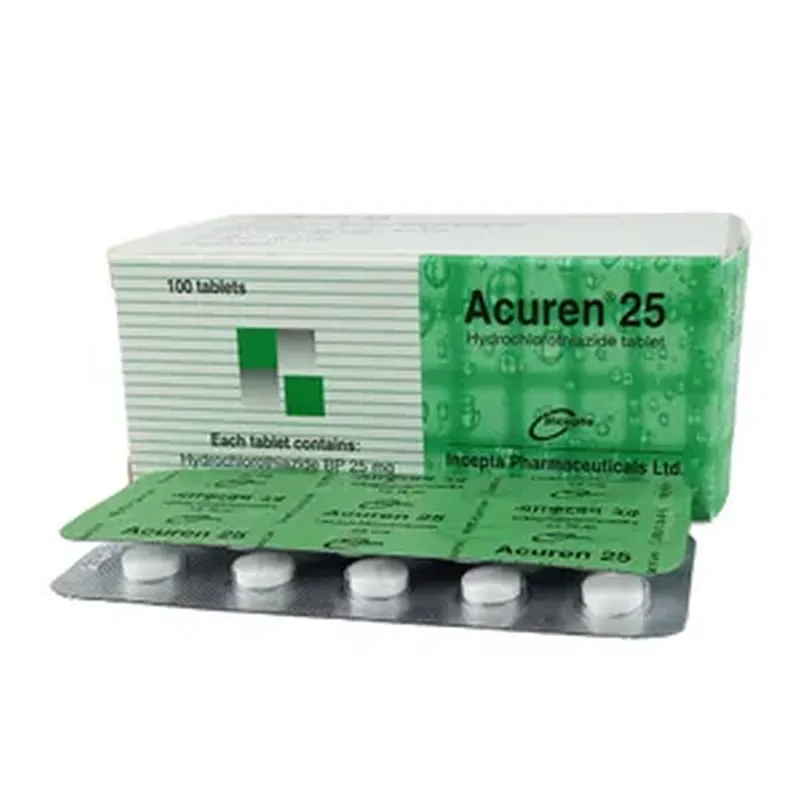
Acuren 25 - Tablet
Hydrochlorothiazide - 25mg
10 Tablet(s) / Strip
Incepta Pharmaceuticals Ltd.
Introduction: Acuren 25 is a diuretic (water pill) medicine used to treat hypertension (high blood pressure). This medicine reduces excess fluid levels in the body and treats edema (fluid overload) associated with heart, liver, kidney, or lung disease. Acuren 25 makes you lose excess water through urine. It may be used alone or in combination with other medicines. This medicine should be taken only during day time to avoid frequent urination at night. You must take this medicine in the dose and duration as advised by the doctor and never stop it abruptly without consulting the doctor. Most people with high...
Uses of Acuren 25: Hypertension (high blood pressure)
Side effects of Acuren 25: HeadacheNauseaIncreased blood uric acidDecreased potassium level in bloodGlucose intoleranceAltered blood lipid level
How to use Acuren 25: Take this medicine in the dose and duration as advised by your doctor. Swallow it as a whole. Do not chew, crush or break it. Acuren 25 is to be taken with food.
How Acuren 25 works: Acuren 25 is a diuretic which lowers blood pressure by removing extra water and certain electrolytes from the body. Over time it also relaxes blood vessels and improves blood flow.
What if you forget to take Acuren 25?: If you miss a dose of Acuren 25, take it as soon as possible. However, if it is almost time for your next dose, skip the missed dose and go back to your regular schedule. Do not double the dose.
Indication: Hypertension, Congestive heart failure, Oedema, Diabetes insipidus, Renal tubular acidosis
Administration: Should be taken with food.
Adult Dose: Oral Hypertension Adult: Initially, 12.5 mg, may increase to 25-50 mg once daily as necessary either alone or w/ other antihypertensives. Elderly: 12.5-25 mg once daily, titrate as necessary in increments of 12.5 mg. Oedema Adult: 25-100 mg daily in 1-2 divided doses or intermittently on alternate days or on 3-5 days a wk. Elderly: 12.5-25 mg once daily, titrate as necessary in increments of 12.5 mg.
Child Dose: Oral Hypertension Child: 2-12 yr 1-2 mg/kg/day in 1-2 divided doses Max: 100 mg daily. Oedema Child: 2-12 yr 1-2 mg/kg/day in 1-2 divided doses Max: 100 mg daily.
Renal Dose: Renal impairment CrCl 10 mL/min: Dose adjustment not necessary; not effective with CrCl <30 mL/min unless used in combination with loop diuretic
Contraindication: Hypersensitivity to sulfonamide-derived drugs, anuria, severe renal impairment.
Mode of Action: Hydrochlorothiazide inhibits the reabsorption of Na and chloride in the distal tubules causing increased excretion of Na and water K and hydrogen ions.
Precaution: Patients w/ electrolyte disturbances, history of gout, allergy or bronchial asthma, DM, parathyroid disease, hypercholesterolaemia. May exacerbate SLE. Hepatic and mild to moderate renal impairment. Pregnancy and lactation. Monitoring Parameters Assess wt, input and output reports daily to determine fluid loss, BP, serum electrolytes, BUN, creatinine. Lactation: Drug excreted in breast milk; use with caution (American Academy of Pediatrics states that it is "compatible with nursing")
Side Effect: Electrolyte disturbances, weakness, hypotension, pancreatitis, jaundice, diarrhoea, vomiting, sialadenitis, cramping, constipation, gastric irritation, nausea, anorexia, aplastic anaemia, agranulocytosis, leukopenia, haemolytic anaemia, thrombocytopenia, anaphylactic reactions, necrotising angiitis, resp distress, photosensitivity, fever, urticaria, rash, purpura, hyperglycaemia, glycosuria, hyperuricaemia., muscle spasm, vertigo, paraesthesias, dizziness, headache, restlessness, renal failure, renal dysfunction, interstitial nephritis, erythema multiforme, exfoliative dermatitis, alopecia, transient blurred vision, xanthopsia, impotence. Potentially Fatal: Hypersensitivity reactions.
Interaction: Increases toxicity of lithium. May potentiate orthostatic hypotension w/ barbiturates and narcotics. Enhanced neuromuscular blocking action of competitive neuromuscular blockers (e.g. atracurium). Increased hypokalaemic effect w/ corticosteroids, corticotropin, beta2 agonists (e.g. salbutamol). Additive effect w/ other antihypertensives. Potentiation of orthostatic hypotension w/ barbiturates or opioids. Reduced antihypertensive effect by drugs that cause fluid retention (e.g. corticosteroids, NSAIDs, carbenoxolone). Enhanced nephrotoxicity of NSAIDs. Reduced therapeutic effect of antidiabetics.
|

No review yet!



LIVE SHOP
(0)
14680 Products
0%
Positive review